He would not enter without permission.
He would not discuss the property unless she raised the subject.
He would not ask for money.
He would not bring apologies expecting immediate comfort.
He signed the paper without complaint.
When he arrived, he stood on the porch holding a paper bag from the bakery and waited until his mother opened the door.
The maple tree had begun to bud.
“Hello,” he said.
“Hello.”
“I brought bread.”
“Put it on the counter.”
He did.
His mother watched him look around the entryway. The house was the same, but he was not. His shoulders were lower. His hair had grown out at the sides. There was a scar near his chin that she did not remember.
“Would you like tea?” she asked.
“Yes.”
They sat in the kitchen.
The first visit lasted twenty minutes. Tommy spoke about the community service, the restitution payments, and the counseling sessions. His mother asked questions. She did not praise him for doing what he should have done. She did not punish him for every silence.
When he left, he paused at the door.
“May I hug you?”
She considered it.
“Yes.”
He stepped forward carefully, as if approaching an animal that might run. She allowed his arms around her. His body shook once, and she felt his cheek against her hair.
She did not say that everything was all right.
She said, “Come back next Sunday if you want to.”
“I want to.”
“Then come.”
The visits continued.
Trust returned by inches.
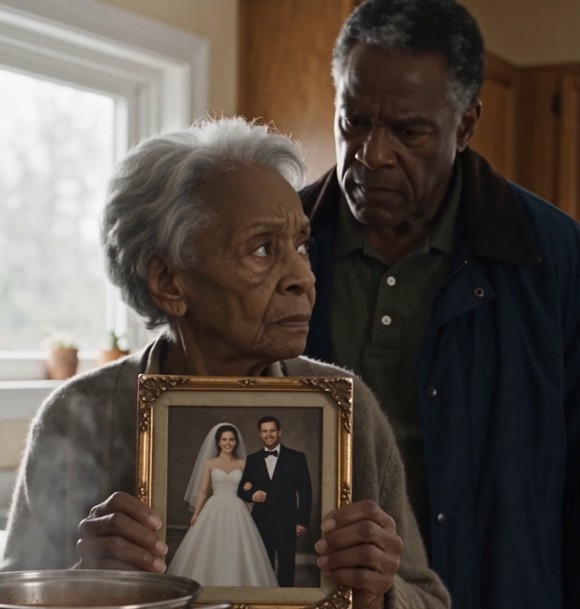
Tommy replaced the cracked glass in the wedding photograph, but his mother kept the old frame. He repaired the loose kitchen cabinet, mended the fence, and painted the back porch. When he finished, he left the receipts on the table.
She paid him for the materials.
He tried to refuse.
She raised one eyebrow.
He accepted.
That was how they learned to live with the truth. Nothing was erased. The house did not become innocent because they had shared soup in it. The cruel words remained cruel. The forged death certificate remained a record of how far fear and greed had carried him.
But the record was no longer the only truth.
One evening, Tommy’s daughter arrived with a box tied in blue string. She placed it on the table.
“What is that?” her grandmother asked.
“Something I found in Dad’s storage unit.”
Tommy, who was fixing a drawer, went still.
His daughter untied the string.
Inside were dozens of envelopes, all addressed to her grandmother.
The old woman lifted one.
Her own name was written across the front in Tommy’s handwriting.
“When did he write these?” she asked.
“Over the last two years.”
Tommy shook his head. “I never sent them.”
“Why not?”
“Because I kept thinking I would send one after I fixed everything.”
His mother opened the first envelope.
The letter was short.
I know you think I am calling because I need something. You are right. I need you to tell me I am still your son. I am ashamed that I need that.
She opened another.
I found your old work badge today. I remembered waiting for you to come home. I used to think you were late because you did not want to see me. Now I understand you were carrying a whole life on your back.
Another.
I am angry at Dad. I am angry at you. I am angriest at myself because I keep choosing the easiest explanation.
The letters continued.
Some were only a few lines. Others filled several pages. In one, he described sitting outside the bank for an hour before lying to the loan officer. In another, he wrote about seeing his mother asleep in the chair and realizing he had been planning to remove the person who had made the house a home.
The old woman read until the light faded.
No one spoke.
Finally, she looked at Tommy.
