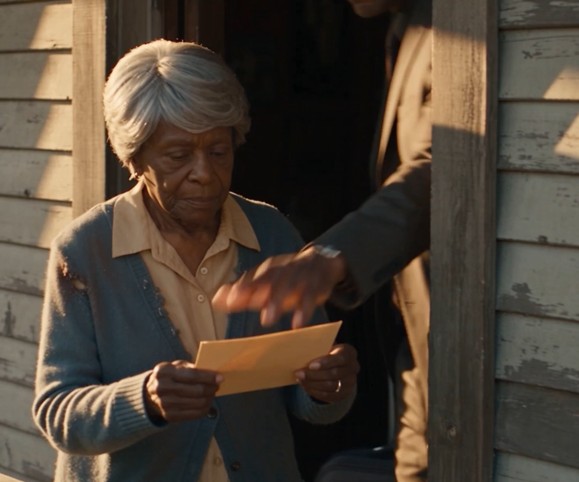
“You’re a burden, Mom. Get out before I call someone.”
Seventy-eight-year-old Ruth stood on the porch of the house where she had raised Daniel. She was a Black American widow, and the man ordering her out was her son.
His vacation suitcase waited beside him.
Ruth looked from the suitcase to Daniel’s face. He spoke as if the decision had already been made, as if the woman who had raised him here had no say in where she could stand.
“This house is ours now,” Daniel said.
Ours.
Ruth’s fingers tightened around the folded deed in her hand. She did not argue about that word. She only held on to the paper, keeping it close enough for Daniel to notice.
He reached for it.
Before she could draw her hand back, he snatched the deed from her fingers. The paper shook once between them, then lay folded in his grip.
For a moment, Ruth said nothing.
She looked at the empty space in her hand, then at her son. Her lips parted, but her breath caught before any words came.
Daniel watched her like he was waiting for her to give in. His suitcase still sat there, a reminder that he could walk away from this porch while she was being told to leave it.
“I know you expected me to leave with nothing,” she said.
Her voice trembled.
But she didn’t reach for the deed again. Ruth only looked at Daniel, waiting for him to read what he had been so eager to take.
He glanced down at the folded paper.
There was a name inside.
Daniel had decided what the house meant to him before he ever looked at what Ruth was holding. He had already announced that it was theirs now, as though saying it would make her leave.
Ruth knew that was what he expected.
She had stood on this porch through the years when Daniel was a boy. Now, at seventy-eight, she was standing in the same place while he spoke to her as though she had become an obstacle.
The folded deed rested in Daniel’s hands.
Ruth’s gaze stayed on it, but her thoughts went back forty years, to when she and Daniel had needed somewhere to go. He knew that part of their story. What he didn’t know was why it mattered now.
Daniel began to open the fold.
Ruth’s hand moved slightly, then stopped. She let him do it himself.
He had taken the paper as if it would settle everything in his favor. Yet with each inch he unfolded, Ruth’s silence felt less like surrender.
His eyes reached the buyer’s name.
He stopped.
Ruth watched his face as he read. Her voice had shaken, but her feet remained planted on the porch where she had raised him.
Daniel’s thumb dragged across the name as though he could rub it off the page.
“The Ruth Bennett Living Trust.”
A car door closed at the curb. He looked up sharply.
Ruth had heard the car arrive, but she kept her eyes on him. One porch board pressed through the thin sole of her shoe. Behind Daniel, through the open front door, she could see her winter coat lying on the floor beside two plastic bags.
“You put the house in a trust?” he asked.
“Last November.”
“You couldn’t do that.”
“It was mine.”
A woman in a charcoal jacket came through the gate carrying a leather folder. Beside her walked a younger woman with Ruth’s same broad forehead. Daniel moved toward the porch steps.
“You brought Claire into this?”
His daughter stopped below him.
“Grandma called me.”
“I told you she gets confused.”
Claire’s gaze traveled past him to the bags inside the door. Her face changed. She climbed the steps and reached down for Ruth’s coat.
The other woman introduced herself as Ellen Ward, Ruth’s attorney. Her voice was quiet enough that Daniel had to stop talking to hear it.
“The deed you’re holding is a certified copy. Ruth remains the trustee and beneficiary. You have no authority to remove her.”
“My wife and I have an agreement with her.”
“Then we’ll examine it.”
Daniel folded the paper badly. One corner buckled under his palm.
Ruth had imagined this moment for three sleepless nights. In her imagination, seeing him understand had felt like relief. In daylight, she could only watch the familiar muscle jump beside his mouth and wonder when she had begun to fear it.
“You promised me this house,” he said.
“When I died.”
“You know what I mean.”
“Yes,” Ruth said. “I’m beginning to.”
His wife, Marlene, appeared in the hallway with a travel purse on her shoulder. She had been listening. Ruth could tell by the stillness of her hands.
“Daniel,” she said, “what trust?”
He did not turn around.
“We’re leaving. They can play lawyer while we’re gone.”
He caught the handle of his suitcase. Ellen stepped aside, leaving the stairs clear.
“Before you go, there’s a separate matter. Ruth has discovered withdrawals from her savings account. She’s asked me to help her report them.”
The suitcase wheels stopped.
Ruth felt Claire move closer without touching her. She was grateful for that small mercy. Everyone had been taking hold of her lately—steering her toward chairs, moving her through doorways, deciding when her body needed assistance.
