“Why did you keep these?”
“Because I wanted to be honest somewhere.”
“Honesty kept in a box cannot protect anyone.”
“I know.”
She touched the top letter.
“You should have sent them.”
“I was afraid you would answer.”
“Afraid of what I would say?”
“Afraid you would not.”
His mother reached across the table.
Tommy stared at her hand before taking it.
She held his fingers.
“I would have answered,” she said.
His eyes closed.
The final letter was different. It had no date.
I have been trying to remember when I first decided that love meant ownership. I thought it came from Dad. Maybe it came from watching you give everything away and believing that if I could make you need me, you could never leave. I am sorry for turning your love into a debt.
His mother read it twice.
Then she placed it on the table.
“I never wanted you to need me,” she said.
“I know.”
“I wanted you to know you could stand.”
“I didn’t.”
“You can now.”
Tommy looked at the house around him. “Can I?”
“You are standing.”
His daughter began to cry quietly.
The old woman reached for her with one hand and kept hold of Tommy’s with the other.
They remained that way until the kitchen grew dark.
Months later, the house became a place where people came for reasons Tommy had once forgotten.
His granddaughter organized a weekly meal there for older neighbors who lived alone. The woman who had been ill when the story began came with a cane and brought cornbread. The pastor from the nearby church repaired the porch steps. Children played in the yard while their parents carried containers home.
Tommy helped in the kitchen.
At first, his mother watched him closely whenever he handled paperwork. Eventually, she allowed him to keep the donation records. He showed her every receipt without being asked.
She never stopped checking.
He never complained.
On the first anniversary of the day he had tried to throw her out, Tommy arrived before sunrise. He carried a new photograph in a wooden frame.
His mother was sitting at the kitchen table, shelling peas.
“What is that?” she asked.
“Open it.”
Inside was a picture taken in the yard. She stood beneath the maple tree with her granddaughter on one side and Tommy on the other. They were not touching. There was space between them, but the space no longer looked like exile. It looked chosen.
Behind them, neighbors filled the porch.
On the back, Tommy had written a sentence.
For the woman who built this house, kept this family alive, and taught us that returning begins with telling the truth.
His mother ran her thumb over the words.
“Who took the picture?”
“Your granddaughter.”
“Why am I looking so serious?”
“Because she told us to stop smiling like we were being arrested.”
His mother laughed.
It surprised all three of them.
The sound rose into the morning air and seemed to loosen something in the walls.
Tommy looked at her. “I brought the original deed.”
She turned toward him.
“It belongs in the house,” he said. “Somewhere everyone can see it.”
She studied him. “That is your final apology?”
“No.”
“What is?”
“Staying honest after nobody is watching.”
She nodded. “That will take longer.”
“I know.”
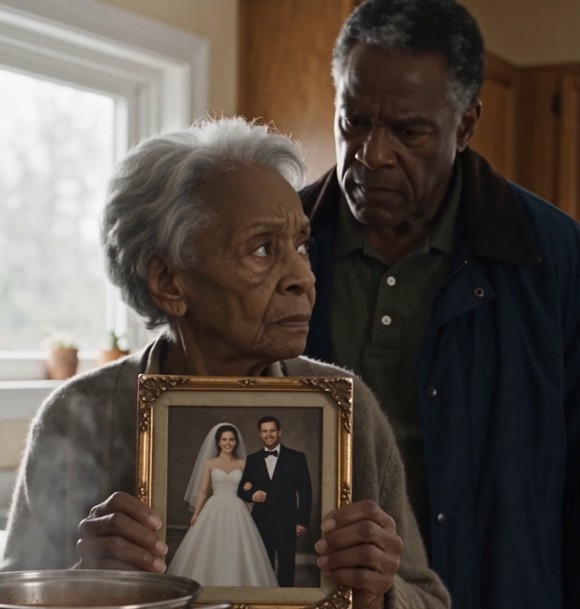
The deed was placed in a simple glass frame in the hallway. Beside it, they hung the wedding photograph. The crack was still visible across the glass because his mother had chosen not to replace it again.
