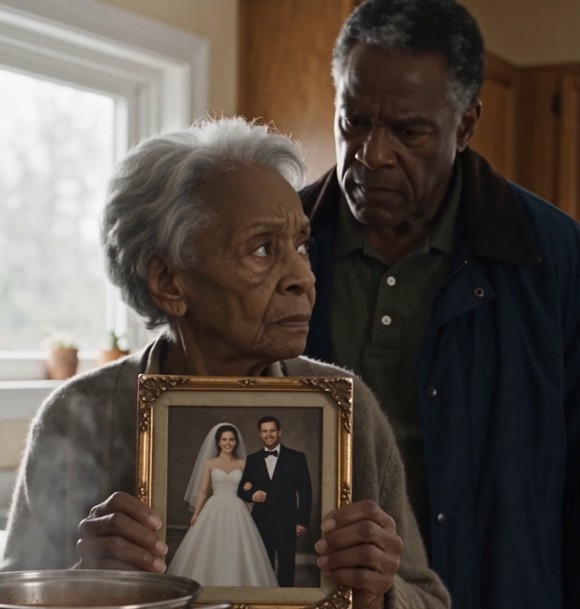
“You thought it would come to me.”
His lips parted, but nothing came.
She opened the door.
The deputy introduced himself and handed the notice to Tommy. The lender’s representative explained that the foreclosure proceedings would be paused pending an investigation into the fraudulent death records and unauthorized documents, but the default still existed.
Tommy held the papers with both hands.
His daughter stood beside her grandmother while the deputy spoke. The words were calm and procedural. There was no shouting, no spectacle, and no dramatic accusation. That made the scene harder to bear. The law did not need to raise its voice. It had arrived with dates, signatures, account numbers, and copies of everything Tommy had tried to hide.
When the officials left, the house seemed larger.
Tommy placed the notice on the table beside the soup.
The old woman looked at it.
“Your father used to say paperwork was for people who did not trust each other.”
Tommy sank into the chair. “I’m sorry.”
His daughter turned toward him. “You need to say what you’re sorry for.”
He looked at her.
“Not just that we found out,” she said. “Tell her what you did.”
Tommy’s hands trembled.
“I took the deed from your desk while you were in the hospital,” he said to his mother. “I made copies. I opened the account using the power of attorney. I told the lender you had died because they asked for proof that you could not object to the transaction. I knew the death certificate was false.”
His mother listened without interrupting.
“I used the money to pay off debts,” he continued. “Some were from the business. Some were mine. I kept telling myself I could recover it before you knew. Then the lender sent the foreclosure notice. I thought if I sold the house quickly, I could pay everyone and put you somewhere comfortable.”
“Somewhere comfortable,” she repeated.
“I would have paid for a nice apartment.”
“Far from here.”
“Yes.”
“Far from my church.”
“Yes.”
“Far from the neighbors who bring me their empty pots.”
He lowered his head.
“Far from the room where I raised you.”
“I know.”
“You did not want to put me somewhere comfortable. You wanted to make my absence convenient.”
The words entered him slowly.
His daughter turned away and gripped the edge of the counter. “How long were you going to keep lying?”
“Until it was done.”
“And Grandma?”
“I thought she would adjust.”
“She is a person.”
“I know.”
“No, you know now.”
Tommy looked toward his mother. “I was afraid.”
She studied him.
“Of what?”
“That I would become nothing.”
“You were never nothing.”
“I lost the business. I owed people money. I couldn’t tell you because you already looked at me like I had failed.”
Her face softened for the first time, but it was not forgiveness. It was recognition.
“I looked at you like I was waiting for you to tell me the truth.”
“I thought you were disappointed.”
“I was disappointed in the lies.”
“I hadn’t told you yet.”
“You had been telling me for years.”
Tommy looked down at his hands.
She moved to the stove and turned off the burner beneath the soup. The metal clicked as it cooled.
“Are you hungry?” she asked.
He stared at her.
“I am not asking because everything is forgiven,” she said. “I am asking because you look ill.”
His mouth trembled. “I don’t deserve your soup.”
“No one earns soup by being good.”
His daughter’s eyes filled.
The old woman ladled three bowls. She placed one in front of Tommy, one in front of her granddaughter, and kept one for herself. The silence that followed was not peaceful. It was full of accusation, grief, and the exhausting work of remaining in the same room.
Tommy lifted the spoon.
He took one mouthful and began to cry.
