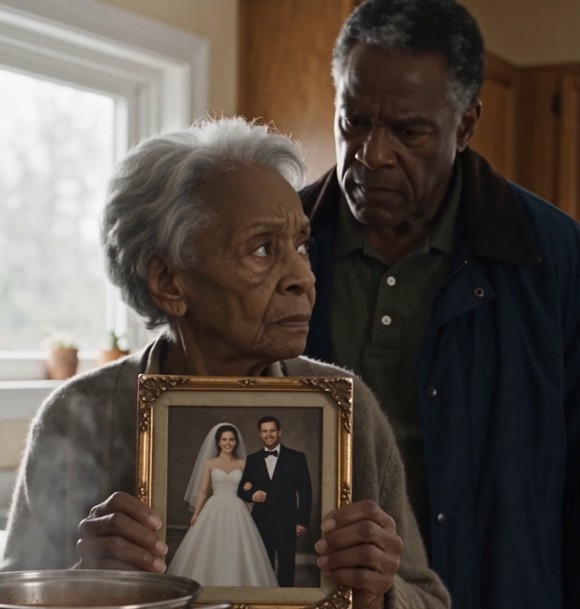
“He left three months later,” she continued. “He took two shirts, his razor, and the money I had hidden in a coffee tin for your school shoes. He said he would send it back.”
Tommy’s daughter listened without moving.
“He never paid for this house,” the old woman said. “He never paid for your braces, your school uniform, or the hospital bill when you broke your arm. He sent one birthday card when you turned eleven. It had no money inside.”
Tommy’s voice cracked. “I know.”
“No, you do not.”
“I know he was gone.”
“You know the story I told you.”
“You told me he was a good man.”
“I told you that because you were a child and I did not want his absence to become your whole understanding of yourself.”
Tommy’s eyes filled.
“I cleaned floors at night,” she said. “I came home when the sun was rising. I slept three hours, packed your lunch, and went back. When your father returned after seven years, you ran to him because you thought he had chosen to come back. I let you run.”
“You never told me he abandoned us.”
“I wanted you to make your own judgment.”
“I thought he left because you drove him away.”
The sentence landed with a force that made his daughter close her eyes.
His mother looked at him for a long moment.
“Who told you that?”
“Dad.”
“He told you that when you were twenty?”
“Yes.”
“He told you because he needed money.”
Tommy’s face collapsed.
“He came to me first,” she said. “He asked for the house. I refused. Then he told you I had trapped him in a miserable marriage and kept you from him. You believed him because you wanted to.”
Tommy pressed both hands to his face.
Calvin remained near the table, silent. The lawyer had come prepared for a legal dispute, but the room had become something older and more painful than a property case.
His granddaughter moved toward the cracked photograph and lifted it carefully. A jagged line crossed the glass above the young bride’s face.
She turned it over.
On the back, written in faded blue ink, were several words.
For my son, when he is old enough to understand that home is something we build.
She read them aloud.
Tommy looked up.
His mother seemed startled. “I had forgotten that was there.”
“Did you write it?” her granddaughter asked.
“No. Your grandfather did.”
Tommy stared at the handwriting.
Calvin took the frame from the young woman and studied the back. “This may be useful.”
“For what?” Tommy asked.
“For establishing the history of the property and your parents’ relationship, if necessary.”
Tommy gave a hollow laugh. “Even now, everything is evidence.”
“Because you made it necessary.”
A car door slammed outside.
Tommy turned toward the window.
Two people stood at the edge of the yard. One was a uniformed sheriff’s deputy. The other was a woman in a dark coat holding a folder.
Tommy’s face went white.
His daughter whispered, “Who are they?”
Calvin closed his briefcase. “The lender’s representative and the deputy serving notice.”
Tommy moved toward the door.
His mother stepped in front of him.
He stopped inches away.
For all his height and anger, he could not make himself push past her.
“Move,” he said.
“No.”
“Please.”
“No.”
The deputy knocked.
The sound traveled through the house.
Tommy looked at his mother, and the old command in his eyes had disappeared. He looked like a child who had finally reached the locked door behind which his consequences were waiting.
“I can explain,” he said.
“You should.”
“I didn’t think it would come to this.”
