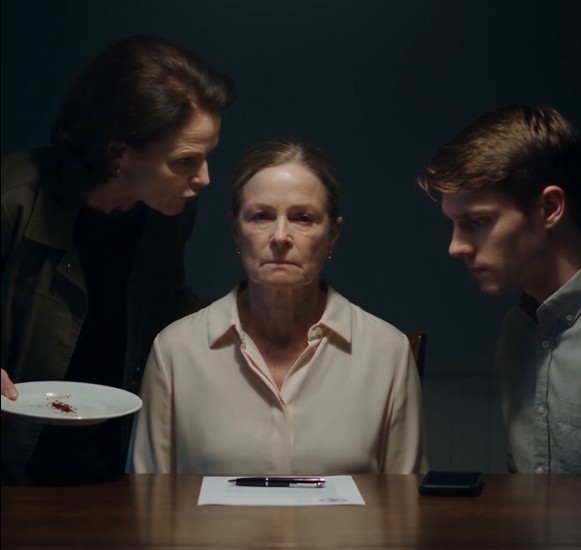
He pushed the folder closer.
There were messages, account details, and a note identifying an account I had never heard of. His attorney said they were arranging to provide everything through the proper channels.
Daniel had discovered it while gathering the records. Vanessa had moved money from the struggling business into an account she controlled alone. The debts were real. So was the reserve she had hidden from him while insisting that my house was their only way out.
“She told me there was nothing left,” he said.
“You knew I was a person, even when you thought there was nothing left.”
He covered his face.
When the twenty minutes ended, he stood without coming toward me.
“I’m sorry, Mom.”
“I believe you are sorry today,” I said. “I don’t know what that will mean tomorrow.”
For once, he did not ask me to make that uncertainty easier.
The investigation took months.
There were afternoons when the detective’s number on my phone made my scalp ache before I answered. I gave statements, located old signatures, and sat with Miriam while she explained documents written in language that seemed designed to conceal the simple fact of theft.
The recorder held Vanessa’s demand, the sharp sound of the blow, and Daniel’s plea afterward. Her earlier messages supplied what the recording could not: planning, instructions, dates.
The loan file contained the forged authority. Account records traced the missing business money. Daniel’s cooperation added detail, but the case no longer depended on him being believed.
Vanessa’s first explanation was an accident. Her second was self-defense. By winter, through her attorney, she was accusing Daniel of arranging everything.
He answered with the messages he had been too ashamed to show anyone.
The last confrontation happened in court.
I had already testified when Vanessa was given the opportunity to speak before sentencing. She wore a gray jacket I remembered helping her choose for a job interview. Seeing it unsettled me more than the handcuffs had.
She began by saying that financial pressure had made everyone behave badly.
Then she turned toward me.
“You knew he was drowning. You could have helped.”
The judge told her to address the court.
But she was looking at Daniel now, where he sat waiting for his own case to conclude.
“Tell her what you told me. Tell her you said she didn’t need that whole house.”
Daniel stood halfway, then sat when his attorney touched his arm.
“I said it,” he answered when the judge permitted him to respond. “It was a cruel thing to say. It didn’t make the house mine.”
Vanessa’s expression hardened.
“You were going to inherit it.”
My son looked across the aisle at me.
“She was still living in it.”
Nobody moved.
For months I had wanted him to understand a fact so obvious that explaining it felt humiliating. He had finally said it aloud in a room where it could no longer save him.
Vanessa turned back to the judge, but her apology had emptied itself. She began talking about what Daniel had promised her, what she deserved, what had been taken from her.
The judge interrupted and returned to the evidence.
Her sentence included years in prison for the assault and fraud. There was a restitution order and an order barring her from contacting me. The attempted claim against my property had already been rejected; the forged document was formally repudiated in the records. Nothing remained for her to sell, threaten, or bargain with.
She had wanted the house without its owner. She left the courtroom with neither the house nor anyone willing to pretend she had been wronged.
I expected relief to feel like warmth.
Instead, I sat on a bench outside and could not remember how to fasten my coat.
Ruth crouched in front of me. Her knees cracked, and that small human sound broke something open.
“She used my good plate,” I said.
“I know.”
“My mother gave me those.”
Ruth took the buttons one at a time.
“I know, sweetheart.”
I cried then, bent over in a courthouse corridor, for the plate and the blood and the dinner I had cooked while my son rehearsed asking me to surrender my home.
Daniel accepted responsibility for his part in the fraud. His cooperation mattered at sentencing, but it did not erase his conduct. He received a custodial sentence followed by supervision and an obligation to repay what he owed.
I did not ask the court to spare him.
I also did not attend his sentencing. Miriam told me afterward what had happened. That afternoon, I stayed in the garden and cut back the roses with Ruth.
A thorn caught my wrist. I cleaned the scratch and put on gloves.
That became the scale of life for a while. Small injuries I knew how to treat. Small decisions nobody argued with.
I began seeing a counselor. At first, I talked about paperwork because it was easier than describing how I still turned toward the telephone whenever I heard a young man laugh outside.
She asked what I missed.
“My son,” I said.
Then, because the distinction mattered, I added, “The son I thought I had.”
She let both things remain in the room.
Daniel wrote from prison. His first letter was four pages long. I could not get past the first paragraph.
I asked Miriam to tell him that explanations frightened me now. I had heard too many explanations for things nobody should have done.
His next letter contained six lines.
He said he had begun counseling. He said the first restitution payment had been arranged from the sale of his car. He said I owed him no reply.
For six weeks, I gave him none.
