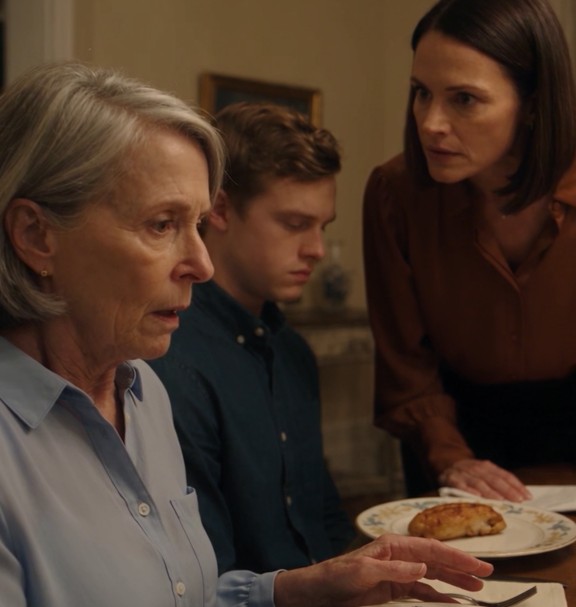
I stood in the garden with Ruth while movers carried boxes down my front steps.
The blue mixing bowl I had lent Bianca came back wrapped in one of my towels.
Nothing else about that afternoon felt ordinary.
Wesley asked through Miriam whether he could speak to me. I agreed to twenty minutes in her conference room.
He arrived thinner, wearing a shirt I had ironed before I knew he was pretending to go to work.
“I keep wanting to tell you I was frightened,” he said.
I watched him twist a paper cup between his hands.
“But you were frightened too. And you still told the truth.”
“What happened when I packed your lunches?”
His face crumpled.
“I ate them in the car.”
“Every day?”
“Most days.”
“Did you ever think, while you were eating, that you should come home and tell me?”
“Yes.”
“But you came home and let her tell me I was living off you.”
His cup split beneath his thumb. Water spread across the table. He grabbed tissues, blotting at it with frantic little movements.
I waited until he stopped.
“That is the part I hear at night,” I said. “Not even the house. You sitting there while she made me small.”
“I know.”
“No. You know now that I heard it. I need you to understand that it was happening before Sunday.”
He nodded without looking away.
“I let it happen because when she was angry at you, she wasn’t angry at me.”
There it was. An ugly truth, plain enough to hold.
“I loved you,” I said, and he winced at the past tense. “I love you. Neither sentence makes you safe for me right now.”
He covered his mouth.
I left when the twenty minutes were over.
In winter, Bianca pleaded guilty to the charges supported by the forged documents and financial records. The agreement required restitution and carried a prison sentence.
At sentencing, she turned toward Wesley as though he might still stand up and rescue the version of events she preferred.
He remained seated.
Her part in the fraud was established in a judgment she could neither charm away nor rewrite. The money was traced, her accounts subject to lawful collection, her claims against my home extinguished.
I expected triumph.
Instead, I felt exhausted, and terribly cold.
Wesley received probation, community service, and a restitution obligation after his own guilty plea. His early admissions and cooperation were considered; his conviction remained. His marriage ended before spring.
I did not pay his attorney or his debt.
When he told me he understood, I believed only that he understood the words. Time would have to tell me the rest.
Ruth drove me home from the final hearing.
Inside, I stood at the dining table, running a finger along a pale scratch near Wesley’s old place.
“Do you want to get rid of it?” she asked.
I considered the table. Birthday cakes had stood there. Homework. Hospital forms. A thousand ordinary suppers.
“No,” I said. “Help me turn it.”
We moved it toward the window, awkwardly, laughing once when a leg caught the rug. Sunlight fell across the place where Bianca had laid the forged paper.
That evening Ruth brought soup.
We ate from the good bowls.
For weeks afterward, I still woke at the sound of a car slowing outside. I checked the lock twice. Sometimes I opened the drawer holding Miriam’s final paperwork simply to see it there.
Healing was embarrassingly practical.
I changed passwords. I chose who could speak to my bank. I learned to say, “I’ll think about it,” without explaining why I needed time.
Ruth finally let me mend the loose seam in her winter coat. She had been refusing because she thought I needed looking after.
“I can need help and still thread a needle,” I told her.
She handed it over.
Wesley found warehouse work and rented a room. He sent monthly restitution payments through the arrangement approved by the court. His letters were short, sometimes painfully so.
He described what he was doing. He stopped telling me how much he missed me, as though missing me were a task I ought to fix.
In April, I agreed to meet him at a café.
He arrived early. When the waitress put the bill between us, he asked whether he could buy my tea.
I said yes.
It was the first thing I had accepted from him since Sunday.
Before we left, he said, “I don’t expect a key.”
“I wasn’t offering one.”
“I know.”
Then, quietly, “I wanted you to know I know.”
