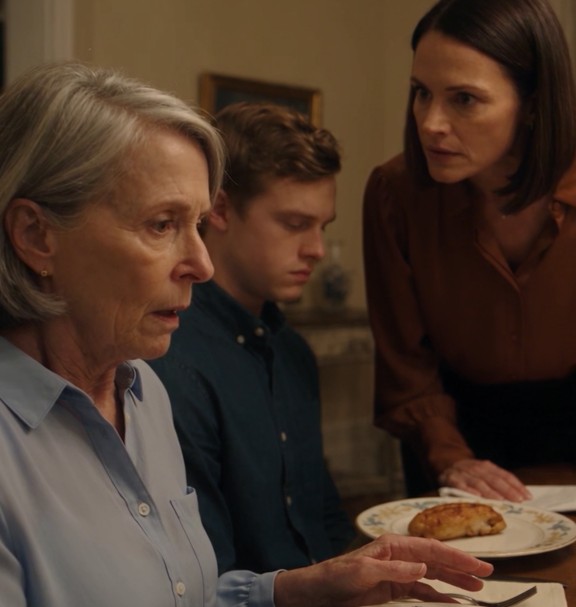
It was a power of attorney.
My name appeared beneath a paragraph giving my son authority over my property. A notary’s stamp occupied the corner. According to its date, I had signed it on a Tuesday afternoon while I was actually sitting in a dental surgery having a cracked tooth removed.
“I signed that too,” Wesley said.
Bianca stepped toward the phone.
He drew it back.
“You said the notary had checked everything.”
“Because you told me your mother agreed.”
“No.” His voice trembled, but he kept it raised. “You told me we would get her agreement afterward.”
“You were happy enough to spend the money.”
“Yes,” he said.
That stopped her more effectively than any denial could have.
“Yes. I was.”
The officer asked them to speak separately. Ruth stayed beside me while the house filled with low voices from different rooms, strangers’ shoes on familiar floors.
I watched a bead of gravy dry on Bianca’s plate.
At some point she passed through the dining room with an overnight bag.
“You’ll lose your son over this,” she told me.
Wesley stood behind her in the hallway.
“Don’t put that on her.”
Bianca looked back at him, waiting for the old silence to return.
It didn’t.
They left separately that evening. Their departure did not resolve their occupancy rights; the officer made that clear. But both agreed to stay elsewhere while the immediate dispute was addressed.
Ruth locked the door after them.
Only then did I begin to shake.
She moved the papers away from the gravy and wrapped the leftovers while I sat with my coat on, although I had never gone outside.
“Eat something,” she said.
“I can’t.”
“All right.”
She put a glass of water within reach and stayed.
At eight the next morning, an attorney named Miriam Vale answered Ruth’s call. By nine-thirty I was in her office carrying a grocery bag of documents because I could not find my briefcase.
Miriam did not tell me everything would be fine.
She asked questions. She made copies. She contacted the title company and the buyer’s attorney while I listened to a clock tapping against the wall.
What Bianca had called a completed sale was a transaction scheduled to close that morning. The buyer’s advance had been paid under a separate agreement; the remaining money had not been released.
Miriam sent written notice disputing the signatures and the supposed authority to sell. The title company suspended the closing pending investigation.
My house was still in danger, she explained. But it was not yet gone.
I put my grocery bag on the floor and cried so abruptly that I frightened myself.
Miriam slid a box of tissues across the desk.
“We’ll take the next thing next,” she said.
The next thing was the buyer, a man named Daniel Mercer, who arrived at the house with his attorney two afternoons later. I expected anger. He stood on the porch holding a folder against his chest.
“My mother was going to live here,” he said.
Behind him, a woman waited in the passenger seat of his car. She had white hair and a walking stick balanced across her lap.
He had been told I was moving closer to family.
For a moment neither of us spoke.
“I’m sorry,” he said finally.
“So am I.”
His lost advance was real. So was my stolen signature. With the lawyers handling the details, he agreed to terminate the disputed transaction and pursue repayment from the people who had taken his money.
Before he left, he glanced at the porch railing.
“She liked the garden,” he said.
I looked toward his mother. She raised one hand through the windshield.
I raised mine.
The investigation took months.
The notary’s journal contained no appearance by me. Bianca had obtained the stamp through an acquaintance who admitted using it without witnessing either signature. There were emails describing me as confused, messages instructing Wesley how to copy my signature, and a voice message Bianca had sent him after he hesitated.
“She won’t put you in prison. She’ll forgive you. Mothers always do.”
The detective played it once in Miriam’s office.
I asked him to stop before he played it again.
Wesley provided his phone and admitted what he had done in a recorded interview with his own attorney present. His cooperation mattered. It did not erase his signatures or the money he had spent.
Bianca hired a lawyer and blamed him.
When the messages made that impossible, she blamed me.
She said I had trapped them with expectations. She said I had offered help and then used it to control them. What I had offered was six months without rent while they saved. They had stayed eleven.
There was no secret bill I had kept. No unpaid debt that made my house theirs.
Miriam obtained the court orders needed to clear the false claims against the property. Wesley and Bianca formally surrendered possession, and their belongings were collected at an arranged time.
