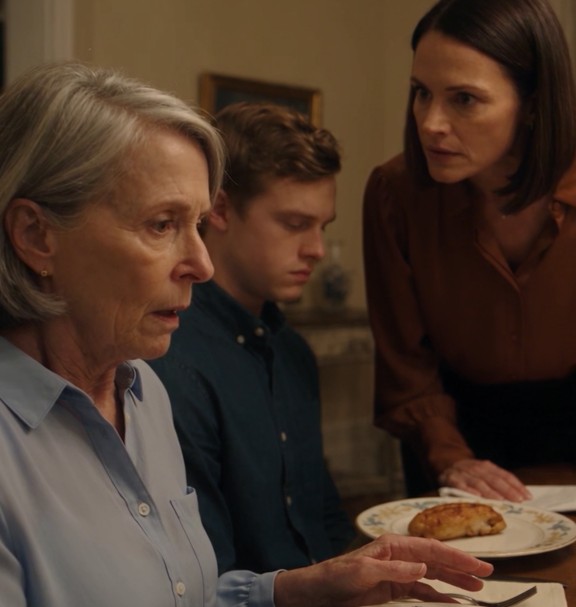
By summer, we could take a walk without spending every minute inside what he had done. Sometimes that felt like disloyalty to the woman at the dinner table.
My counselor asked what that woman had wanted.
“A home,” I said. “And a son who would look at her.”
“Are those things becoming possible?”
I could not answer immediately.
But I thought about the question all the way home.
The last box of original documents came back from Miriam’s office in August. Beneath old insurance policies lay a blue envelope I had seen for years without opening.
It had been tucked into the original closing file by my mother.
I had always assumed it contained receipts. She had kept receipts for everything, folding them into envelopes until the paper went soft.
Inside was a bank draft, a letter to the closing attorney, and a page addressed to me.
The amount on the draft matched our first down payment.
For a long time, I simply stared.
I had believed that money came from my husband’s savings. He had died years before the Sunday dinner, leaving memories I had worn smooth with handling.
Now I read my mother’s handwriting.
She had provided the money herself.
Years of cleaning offices before dawn. Small deposits. Extra shifts she had said were necessary for her own expenses.
Her letter instructed the attorney to treat the money as a gift to me and ensure my name appeared on the ownership documents.
Then I unfolded the page she had written for me.
“Your husband wanted to save longer. I told him a child needs a garden before he grows too old to dig it up.”
I laughed, a broken little sound.
Below that, she had written, “He wanted me to tell you. I said I would when you stopped feeling you had to repay every kindness. Perhaps this letter will have to do.”
She had died that first winter in the house.
We had been so busy grieving her that the closing file went into a drawer and stayed there.
At the bottom, beneath a blot of ink, were four more lines.
“I have spent my life working in rooms where I could be asked to leave. I wanted you to have one place where you could close the door and rest.”
I put the letter flat on the table because my hands would not hold it steady.
Bianca’s words had made my home sound like evidence of my uselessness.
But my mother had put it into my hands as permission to stop earning every breath.
I called Wesley.
“Would you come tomorrow? There’s something I want you to read.”
He read the letter standing by the window. When he reached the end, he sat down without asking.
“Grandma paid for it?”
“The beginning of it.”
He looked toward the garden where she had once taught him to bury beans beneath a finger’s depth of soil.
“I almost—”
“Yes,” I said.
He bent over the letter. I let the silence remain.
Then he asked, “Can you tell me about her working?”
So I did.
I told him about the lemon smell on her coat, the swollen knuckles, the little packet of biscuits she brought me from her break. I told him how fiercely she disliked pity, and how she sang when she polished shoes.
He listened until the afternoon light left the window.
Before he went, he asked permission to hug me.
I stepped into his arms.
It did not restore everything. It gave us one honest thing to carry forward.
The following spring, Daniel sent a photograph through Miriam. His mother sat on a small porch with pots of red geraniums at her feet. They had found another house.
I put the photograph beside my mother’s letter.
On Sunday, Ruth came for dinner. Wesley brought bread and arrived when invited. He waited on the doorstep until I opened the door.
We ate with the windows cracked to the garden.
At one point, I dropped my fork. Wesley picked it up and brought me a clean one without making a ceremony of it. Ruth argued that I had put too much pepper in the potatoes, then took another spoonful.
Later, my son washed the dishes while I dried.
“I’m glad you made the complaint,” he said, looking into the sink. “I wish you’d never needed to.”
I set a plate in the cupboard.
“So do I.”
He nodded.
Outside, the porch light caught the first moths of the evening. When he left, he hugged me gently and walked to his car. Ruth went home through the garden gate.
I locked my door once.
The house settled around me, pipes ticking, curtains lifting in the cool air. On the table lay my mother’s letter, its creases softened by hands that no longer shook.
I switched off the kitchen light and sat beside the open window.
There was nothing left to prove before I could rest.
