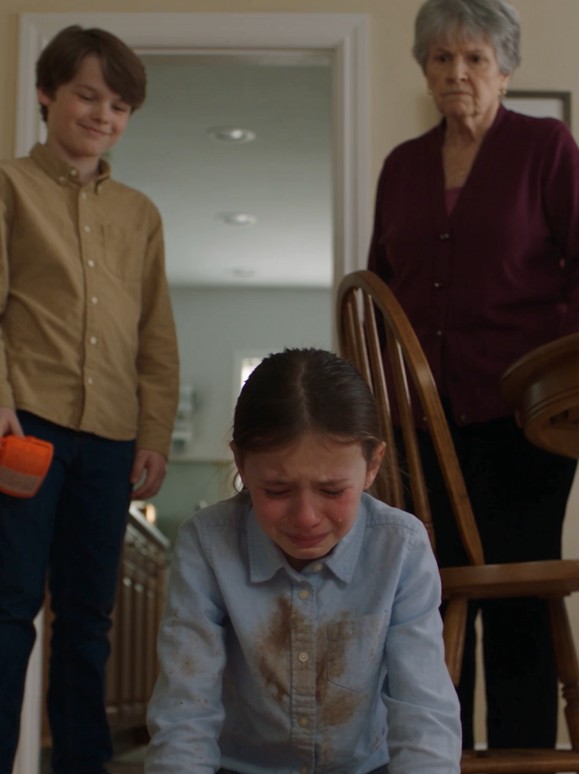
“I want to be a child in my own house.”
The judge granted the protective order and ordered supervised family counseling only if my daughter ever requested it in the future.
She did not.
After the hearing, Daniel stood outside the courthouse beneath a bare tree. The wind lifted the edge of his coat.
His mother was led past him by her attorney.
She stopped.
For a moment, I thought she might apologize.
Instead, she said, “You have no idea what you’ve done to me.”
Daniel looked at her.
“I know exactly what I did.”
“You destroyed your family.”
“No,” he said. “I stopped helping you destroy mine.”
She searched his face for hesitation.
There was none.
Her attorney touched her elbow.
She turned away.
Daniel watched her go until she disappeared through the courthouse doors.
Then he sat on the stone steps and covered his face.
I sat beside him.
“I thought I would feel free,” he said.
“You may feel many things.”
“I feel like a son who buried his mother.”
“She is alive.”
“I know. That’s what makes it complicated.”
I leaned my shoulder against his.
He cried quietly, not with the terror of a child expecting punishment, but with the grief of an adult finally allowing himself to mourn what he had never received.
Weeks passed.
We changed the locks. We moved the furniture. Daniel painted over the wall where the chore sheets had been taped. My daughter chose the color: a bright yellow that looked almost gold in the afternoon sun.
She refused to let us throw away the toys.
“They’re not bad,” she said. “Grandma was bad to use them that way.”
We placed the toys in a low wooden chest. The stuffed rabbit went on her bed.
Therapy helped, though not in a straight line. Some mornings she was energetic and loud. Other mornings, she asked three times whether she was allowed to choose her own breakfast.
The first time she asked, I put two bowls on the table.
“You can choose,” I said.
“Really?”
“Really.”
“What if I choose wrong?”
“There is no wrong breakfast.”
She studied the bowls.
Then she chose cereal, added too much milk, and laughed when it turned soggy.
I laughed too.
The sound felt unfamiliar in the kitchen at first. Then it became ours again.
Daniel began therapy as well. He learned that obedience had not made him safe as a child. It had only made his mother’s control invisible to everyone else.
One evening, he found me folding laundry in the living room.
“I remembered something,” he said.
I set down the shirt in my hands.
“When I was ten, my mother kept a notebook about me.”
I looked at him.
“She wrote down every time I disappointed her. I thought she threw it away. She must have used the same system with our daughter because it was the only way she knew how to feel powerful.”
“Did you find it?”
“No.”
He sat on the floor beside the laundry basket.
“But I remembered the cover. Blue flowers. She kept it under the kitchen sink.”
I felt a chill.
The next day, with the advocate’s permission, we searched the storage unit where my mother-in-law had kept her belongings.
There it was.
A blue-flowered notebook inside a metal box.
Daniel opened it with shaking hands.
The first pages were about him.
“Cried during punishment.”
