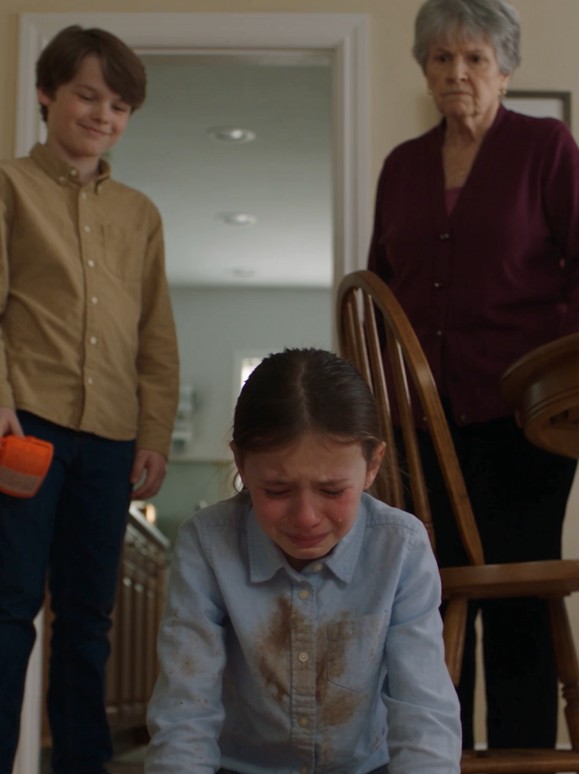
“She is my mother,” he said. “I love the person I wanted her to be. I remember good things too. She made soup when I was sick. She taught me to ride a bike. She was there when I needed stitches.”
My daughter listened.
“But love does not erase what she did,” he continued. “And remembering good things does not require us to accept dangerous things.”
“Can you love someone and not let them come inside?”
“Yes.”
“Can you love someone and tell people the truth?”
“Yes.”
She nodded slowly.
“Then maybe you can still love her from far away.”
Daniel looked down at the table.
“That is what I am going to learn.”
The investigation moved quickly because the pages were so detailed. My mother-in-law had recorded not only chores but punishments, meals withheld, periods of isolation, and times when my daughter had been required to stand facing a wall while her cousin watched.
Some entries described ordinary childhood behavior as defiance.
“Asked why.”
“Spoke while adult was speaking.”
“Needed reassurance.”
Each sentence had been treated as evidence of a character flaw.
The counselor at my daughter’s school noticed the change before anyone else did. She stopped raising her hand in class. She apologized whenever another child bumped into her. During an art project, she drew a house with one black window and a small figure outside the door.
The counselor asked what the picture meant.
“That’s where I had to wait,” my daughter said.
The school contacted me.
I sat beside my daughter in the counselor’s office while she explained what had happened. Sometimes she spoke clearly. Sometimes she stopped and twisted the sleeve of her shirt. No one rushed her.
Daniel attended the next meeting.
He listened while the counselor described trauma responses, and he wrote everything down. When she said my daughter might need time before she trusted adults again, he nodded.
“I understand,” he said.
My daughter looked at him.
“Do you?”
“I’m trying to.”
“That’s different.”
“Yes,” he said. “It is.”
The cousin’s family filed their own report. His mother discovered that her son had been made to stand outside in the cold for refusing to order my daughter to clean a spilled drink. He had not told anyone because his grandmother had threatened to make his parents think he was cruel.
The boy’s father wanted to confront her immediately.
Instead, the families met with a child advocate, who warned them that anger could make the children feel responsible for the adults’ conflict. They listened. They learned to ask questions without turning the children into witnesses at a trial.
My mother-in-law’s attorney sent a letter claiming that the children had been manipulated.
The claim collapsed when the investigators found the lists, the matching entries in my mother-in-law’s private calendar, and a voice recording on an old tablet.
My daughter had found the recording by accident.
She had been looking for a cartoon, but the tablet had opened to an audio file dated six months earlier. Her grandmother’s voice filled the room.
“Say it again,” she ordered.
My daughter’s younger voice, small and frightened, answered, “I am difficult.”
“Louder.”
“I am difficult.”
“What happens when you are difficult?”
“I lose privileges.”
“And who decides when you are difficult?”
“Grandma.”
The recording ended there.
I listened to it in the attorney’s office with Daniel beside me. The first time, I felt rage. The second time, I felt something worse.
I heard how hard my daughter had tried to give the correct answers.
Not because she believed them.
Because she believed the wrong answer would cost her another hour alone.
The evidence led to a protective order. My mother-in-law was prohibited from contacting either child directly or through other relatives. She was required to attend an evaluation and could not return to the house to collect her remaining belongings without supervision.
Her downfall did not happen in one dramatic courtroom confession.
It happened through a series of doors closing.
The family members who had defended her stopped answering her calls. Her church group learned why she had been asked to step down from volunteer work with children. The neighbors who had heard her shouting through open windows gave statements about seeing my daughter sitting alone on the porch.
The woman who had built her authority by convincing everyone that children were unreliable discovered that written proof, repeated testimony, and her own voice were stronger than her reputation.
At the hearing, she wore a gray suit and held herself perfectly still.
My daughter did not have to testify in the room. The advocate read her statement.
“I thought my mother would be disappointed in me if I told her. Grandma said she would think I was bad. I tried to be good enough that Grandma would stop being angry, but she always found something else.”
My mother-in-law stared at the floor.
Then the advocate read the final line.
