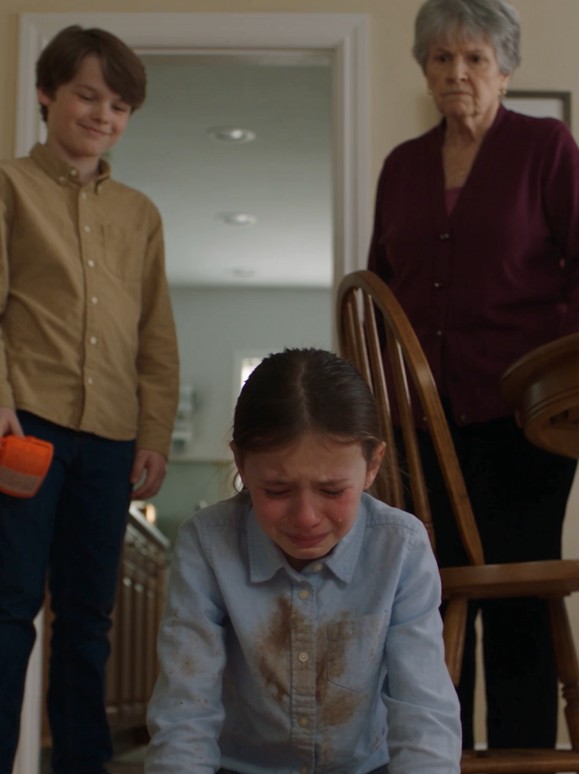
“Refused to finish dinner.”
“Needs stronger correction.”
The language was almost identical to the pages about my daughter.
But halfway through the notebook, the writing changed.
The entries became less like records and more like letters.
“I am trying to make them strong enough to survive me.”
Daniel stopped reading.
“What does that mean?”
I moved closer.
He turned the page.
“I know what I am doing is wrong. I know I become the person I hated. But if I let them be soft, someone else will hurt them. If I hurt them first, perhaps they will learn to withstand it.”
The next page contained a single sentence.
“Love is the only thing I know how to turn into a weapon.”
Daniel closed the notebook.
The discovery did not excuse her.
It did something more painful.
It showed that she had understood herself well enough to recognize the harm and had continued anyway.
Her cruelty had not been an accident born of ignorance. It had been a choice repeated in the name of protection.
That was the final truth.
The hidden notebook had changed how we understood the lists. Not because it made her innocent, but because it revealed the terrible origin of the pattern. She had taken the fear that shaped her and passed it down with both hands, calling the transfer love.
Daniel read the notebook to his therapist. He did not show it to my daughter.
Some truths belonged to adults.
One afternoon, months after the hearing, my daughter asked whether her grandmother would ever apologize.
“I don’t know,” I said.
“What if she does?”
“You can decide whether you want to hear it.”
“What if I don’t?”
“Then you don’t have to.”
She considered that while drawing at the kitchen table.
“Would you hear it?”
“I might.”
“Why?”
“Because I want to understand what she is willing to admit.”
“Would you forgive her?”
“I don’t know.”
“Does forgiving mean she can come back?”
“No.”
She pressed her crayon harder against the paper.
“Then what does it mean?”
“Sometimes forgiveness means letting go of the hope that someone will become different. It does not mean forgetting. It does not mean trusting them again.”
She looked at the yellow wall.
“Can I forgive her and still be mad?”
“Yes.”
“Can I love the grandma who made pancakes and hate the grandma who made lists?”
“Yes.”
Her shoulders lowered.
“I think I do.”
I kissed the top of her head.
“That makes sense.”
The first holiday without my mother-in-law was quiet.
No one expected her to arrive with a criticism disguised as a greeting. No one watched the clock. No one measured the children’s voices.
Daniel cooked too much food. The cousin came over with his parents. The children built a fort in the living room and left blankets everywhere.
At one point, my daughter stood in the doorway holding a plate.
“I made this for everyone.”
The cousin looked at the uneven sandwiches.
“They’re crooked.”
She stiffened.
His mother gave him a warning look, but my daughter began to laugh.
“They are. I made them that way.”
The boy picked one up.
