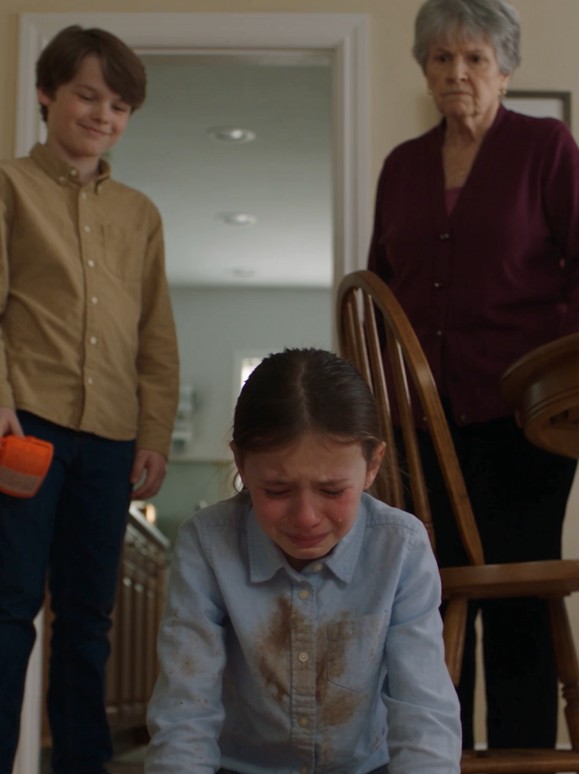
“When?”
“In the car. I said I didn’t want to go to Grandma’s.”
“You said you were tired.”
“Because I was scared you’d be mad.”
She pulled him closer.
“I am not mad. I believe you.”
The boy looked toward my daughter.
“Can she come home with us?”
My daughter glanced at me.
I nodded.
The cousin’s mother gave us her address and asked whether we could talk the next day. She wanted to compare what the children remembered. She also said she would contact the school counselor because her son had begun having stomachaches on the mornings he visited his grandmother.
The family that had been arranged around silence began, awkwardly, to rearrange itself around truth.
That night, my daughter slept in my room.
She had not asked to. She simply stood in the hallway in her pajamas, holding the stuffed rabbit she had been forced to retrieve from the floor.
I lifted the blanket.
She climbed in without speaking.
A storm moved across the city. Rain tapped against the window, and headlights passed over the ceiling in pale stripes.
“Mom?”
“I’m here.”
“Can I ask something?”
“Anything.”
“Did Grandma hate me?”
My throat tightened.
“I don’t know what she felt. But she treated you in a way that was wrong.”
“Why?”
“Because some people confuse control with love.”
“Did Dad know?”
“Not about the lists.”
“Would he have stopped her?”
I looked at the sleeping outline of my husband beside us. Daniel had stayed downstairs for hours, calling a lawyer, speaking with the school, and arranging for his mother’s belongings to be collected from our house with an officer present. Eventually, he had come upstairs and sat on the edge of the bed, unable to meet our eyes.
“Yes,” I said. “He knows now.”
My daughter turned toward me.
“Will he be mad at me?”
“No.”
“Will he make me go back?”
“No.”
She was quiet for a moment.
“Then why did he let me go before?”
I had no easy answer.
“Because he did not understand what was happening.”
“That’s not the same as making it stop.”
“No,” I said. “It isn’t.”
She accepted that more easily than I expected. Children did not always need adults to make the past sound better. Sometimes they needed the past named correctly.
In the morning, Daniel sat across from us at the kitchen table. He had not slept. His eyes were red, and he kept rubbing the edge of the oldest paper with his thumb.
“I need to tell you both something,” he said.
My daughter held her spoon without eating.
Daniel looked at her first.
“I failed to protect you.”
She lowered her eyes.
“I believed Grandma because believing her was easier than admitting I had been afraid of her my whole life.”
His voice broke slightly.
“That was not your fault. It was mine.”
My daughter looked at him.
“Are you going to send her away?”
“She has to leave the house. She cannot see you without permission from your mother and the court.”
“Is she going to jail?”
“We don’t know.”
“Do you still love her?”
Daniel sat back.
The question seemed to empty the air from his lungs.
