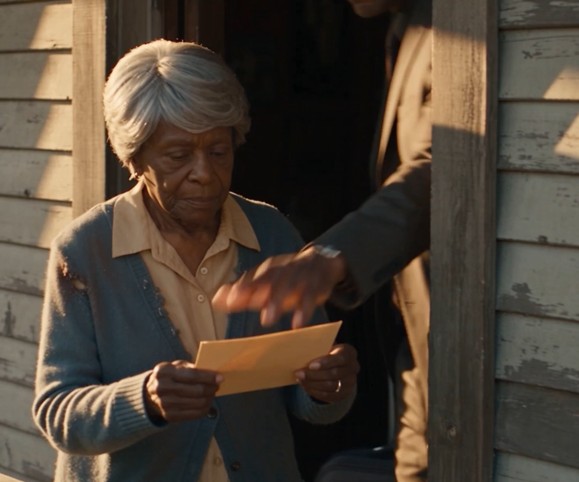
“This came from the seller’s archived file,” Ellen explained. “Her granddaughter found it when we asked for the historical closing papers. She thought you should have it.”
The seller had been Evelyn Mercer.
Forty years earlier, Ruth and twelve-year-old Daniel had arrived in town with two suitcases after the apartment building where they lived was condemned. Ruth had work, a little saved money, and nowhere that would rent to her on terms she could afford.
Evelyn had offered her this house through an installment purchase agreement. Ruth had always assumed her employer supplied the reference that persuaded her.
Inside the envelope was a sheet of ruled notebook paper.
Ruth recognized Daniel’s childhood handwriting.
Dear Mrs. Mercer, it began.
Claire sat very still beside her.
The boy had seen the house advertised in the grocery store window. Without telling Ruth, he had written to its owner.
My mom works nights sometimes but she always comes back. We can pay something every month. She thinks I don’t know she sleeps sitting up so I can have the bed where we’re staying.
Ruth pressed her fingers to her lips.
The final lines slanted uphill.
If we lived in your house I would help her take care of it. I mostly want a place where nobody can tell her to get out.
Behind the letter was Evelyn’s reply, never mailed, apparently kept with her notes.
I went to meet the mother today. She asked about the furnace before she asked about the curtains. Proud woman. Exhausted. Reliable references.
Then, beneath that practical assessment:
The boy thinks he is asking me to rescue them. He has brought me the family this house needs.
Ruth folded forward over the table.
Claire reached for her, then waited. Ruth caught her hand.
For years, the memory of their arrival had been all hunger and shame: a borrowed room, counting coins, pretending she had already eaten. Hidden inside it had been a small boy trying to protect her.
The man he became had not erased that boy. Nor did the boy’s kindness erase the man’s crimes.
Both truths fit on the table.
“Once,” Ruth whispered, “he wanted me safe.”
Claire was crying now.
“Yes.”
Ruth touched the crooked handwriting.
“I wasn’t foolish every time I loved him.”
“No, Grandma.”
Outside, someone’s screen door banged. Ruth laughed through a breath that hurt, remembering Daniel racing across this porch at twelve, pretending he had never seen the place before.
“He kept that secret all these years.”
She had the letter preserved in a simple frame. It did not go over the mantel or beside her bed. She placed it in the small room where she kept old photographs, among things she could visit when she chose.
By autumn, she had decided what the house would become after her death. An amended trust provided for its eventual transfer to a local housing charity, with funds to maintain it as a home for a parent and child rebuilding their lives.
Until then, it was hers to live in.
She interviewed the charity’s director herself. She asked about repairs, tenant rights, and who would answer the telephone when the furnace failed. Ellen smiled only after Ruth finished.
On the first cool Sunday, Claire and Mrs. Alvarez came for supper. Ruth made too much rice. Claire burned the edges of the cornbread, and nobody pretended otherwise.
They ate it anyway, with butter.
Later, Ruth carried her tea to the porch. The coat hook inside held her coat. Her photographs stood upright. Her new key rested in her own pocket.
Claire brought out a blanket.
“May I?”
Ruth nodded, and her granddaughter tucked it around her knees.
Across the street, kitchen windows glowed. Somewhere a child was being called home. Ruth listened until the running footsteps faded, then leaned back in her chair.
There was room beside her, and someone she loved sat down.
