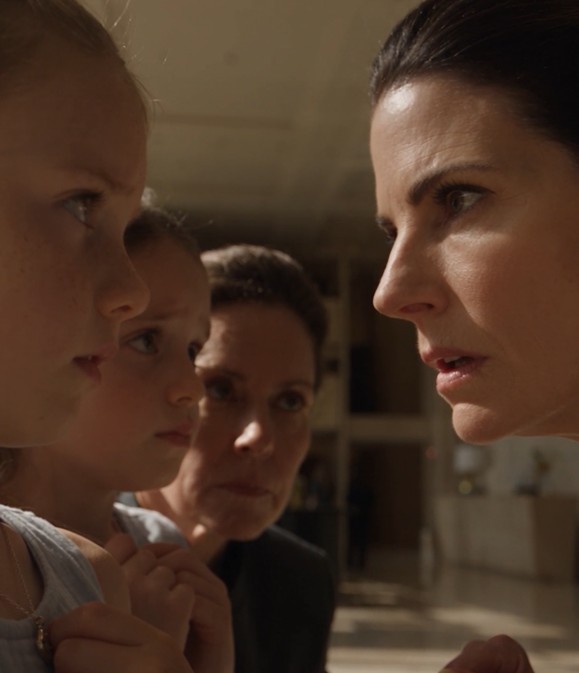
“Then let’s check,” Theo said.
Every face turned toward the desk clerk. His cheeks reddened, but he kept speaking. “The hotel radio system records dispatch traffic. Security asked me to disable the lobby camera at three fourteen. I didn’t. I saved the request and sent it to the general manager when it happened.”
The security director said, “You had no authority to do that.”
“You had no authority to ask.”
One officer asked Theo to preserve the recording and camera footage. The other asked Sarah whether she and the girls would speak to them in a quieter room. Sarah said yes, provided Elena could come and the girls would remain with her. The officer agreed.
Richard blocked their path. “I arranged this because I knew she’d never let us help.”
No one answered. He seemed to hear his own admission only after it had settled in the lobby. His lawyer shut his eyes.
Sarah looked at her father. “You made me lose them.”
“I knew where they were going. They were never in danger.”
The younger girl buried her face in Sarah’s coat. Richard glanced at her, and for the first time he appeared unsure what to do with the sight of a child he had frightened.
“You didn’t know that,” Sarah said. “They walked through traffic alone. I didn’t know where they were. They didn’t know where I was.”
Richard straightened. “I was trying to bring this family back together.”
“You could have called.”
“You never answered.”
Sarah remembered the calls after Daniel died, all from numbers she did not recognize. She had let them ring while she fed the girls, paid bills, and sat beside a bed that suddenly had too much room. Richard had taken that silence as permission to arrange a reunion she could not refuse.
“Your driver stopped me on purpose,” she said. “You took my choice away again.”
A uniformed manager arrived and recognized Richard immediately. Then he saw the officers and Theo’s open incident log. He asked the security director to hand over his radio and access badge. The man refused until an officer repeated the request for the radio and the manager made clear that his access had been suspended. The small click of the badge landing on the desk carried across the lobby.
In a private conference room, the girls sat on either side of Sarah while Elena gave her account. The air conditioner hummed above them. A pitcher of water stood untouched beside a stack of paper cups. When the older girl could not remember which street they had crossed, Sarah told her she did not have to guess. The officer thanked her for saying so.
Eleanor waited outside until Sarah came to the door. They stood facing each other under a light too bright for either of them to hide much.
“I heard him make the arrangements,” Eleanor said. “I should have stopped him before today.”
“Yes.”
“He told me the driver was meant to help you. That you’d be upset when you saw us, and he wanted everyone brought here.” Her fingers found the seam of her sleeve, over the place Richard had gripped. “I believed the part that let me see the girls.”
Sarah leaned against the doorframe. “You recognized their necklaces.”
“I did.”
“Daniel made them.”
Eleanor nodded. Her eyes filled, but she did not ask Sarah to comfort her. “He came to see me once, before they were born. He asked for the drawing of the lighthouse.”
Sarah went still. “You met him?”
“At a café. You wouldn’t speak to me, and he said that was your right. He wanted to know what made you happy when you were little.” Eleanor gave a brief, broken laugh. “I talked for an hour. I sent him the drawing afterward.”
Sarah remembered Daniel at the kitchen table, keeping his hands over two unfinished pieces of silver whenever she passed. He had told her they were a surprise. She had worn neither pendant herself; after he died, the girls refused to take them off.
“He never told me,” she said.
“He made me promise I wouldn’t use the visit to reach you. He said you would decide if and when you were ready.” Eleanor looked toward the closed conference-room door. “I thought I’d have years to earn that day.”
“You had years.”
“I know.”
Sarah could not take in more. She returned to the girls, and Eleanor let her go.
By evening, the officers had obtained the hotel recordings and the transit camera footage. The footage showed Richard’s driver indicating Sarah’s fallen bag, then signaling to a second man near the bus door as Sarah turned back. That man kept the girls from stepping off before the doors closed. Neither man accompanied them after they left the bus two stops later. Richard had known the plan; the children had still been left to find safety themselves.
The radio recording captured the security director reporting their arrival, followed by his request to clear Elena from the lobby. Theo’s saved log showed exactly when the request had been made. The lawyer, shown those times, acknowledged that the petition had been prepared before anyone at the hotel spoke to Sarah. What he had been told about her leaving the girls unattended did not match the evidence.
Richard was taken in for questioning that night. He looked back once as the officers led him through the lobby. Sarah was sitting between her daughters, reading the same page of a picture book for the third time. She did not see him leave.
The girls slept at home, though each woke to check that Sarah was there. She left the hall light on. At dawn the younger one came into her room carrying both necklaces and asked whether their grandfather had known Dad.
“No,” Sarah said. “He should have had the chance.”
The girl laid one pendant in Sarah’s palm. Its edges were worn smooth from years beneath a small thumb.
“Are we in trouble for getting on the wrong bus?”
Sarah pulled her close. “No. The bus left before you could get off. You found help, and you stayed together.”
The older sister appeared in the doorway, awake in time to hear it. “I was supposed to hold her hand.”
“You did,” Sarah said. “And when you were scared, you asked someone to stay. That was brave.”
The girl climbed onto the bed beside them. For a while they listened to a delivery truck rumble past and to the familiar pipes knock behind the bathroom wall. At last the older one asked whether they would see Elena again.
“She asked me to tell you she’s all right,” Sarah said. “We can visit when everyone’s ready.”
In the weeks that followed, the hotel dismissed its security director. Elena kept her job. The manager apologized to her in the lobby, where the threat had been made, and changed the policy so an employee who stayed with a lost child could not be ordered away from them. Theo was asked to help train the front-desk staff. He showed them the call log, though he still blushed when Elena thanked him.
Sarah gave her statement. Eleanor gave hers separately, including what she had heard before arriving at the hotel. Richard’s driver and the man at the bus door identified who had hired them. Richard’s lawyers tried to describe the separation as a misunderstanding; the recordings and his own words in the lobby made that account impossible. He pleaded guilty to charges arising from the plan and the false account used to support his petition. A court barred him from contacting Sarah or the girls, and he lost the position he had held at the family foundation. Eleanor did not visit him. By then she had moved out.
None of that restored the hour Sarah had spent looking for her children. She still turned sharply at bus doors, and the older girl still watched the street through the window when Sarah was late. They talked about it on those days. Sometimes the girls wanted details; sometimes they only wanted to sit close until the feeling passed.
One Saturday, Elena met them at a park. She came in ordinary clothes, carrying a bag of oranges and looking strangely shy without her badge. The younger girl ran to her. The older one followed more slowly, then wrapped both arms around Elena’s waist.
“I thought you might have been fired,” she said.
“I thought so too,” Elena admitted. “But I’m still there.”
Sarah had rehearsed a thank-you on the drive over. Standing in front of Elena, she could manage only, “You stayed.”
Elena touched the older girl’s shoulder. “They knew who they were waiting for.”
They ate oranges on a bench while the girls played within sight. Elena told Sarah that when she was young, she had once lost her brother in a crowded market. He had turned up behind a fruit stall, eating a peach someone had given him. Her mother had been too relieved to scold either of them.
“I remembered that feeling when I saw your girls,” Elena said. “I knew somebody was coming through those doors for them.”
A month later, Eleanor wrote Sarah a letter. She did not ask to be forgiven. She told Sarah what had happened the day Daniel visited her: how he had listened to every childhood story, how carefully he had folded the lighthouse drawing, how he had said he wanted their children to know there was a place their mother had once felt safe. She enclosed the drawing, creased where he had carried it home.
Sarah spread the paper on her kitchen table. The lighthouse was crooked. One star had five points and the other had six because, at eight years old, she had lost count. Daniel had copied both exactly.
There was another sheet behind it, smaller and softer with handling. It was a note in Daniel’s writing, dated several years before his death. Eleanor had found it tucked inside the fold when she went to send the drawing.
Sarah, I know why you don’t want to go back. I went because I wanted to bring you something from before it hurt. Your mother remembered the good parts. She told me you drew the lighthouse so people could find their way home.
