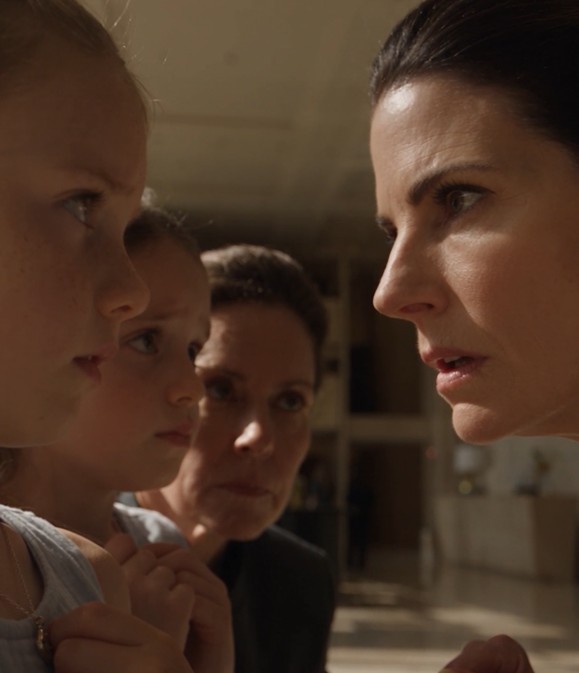
“What did he look like?”
“Gray jacket.” Her voice thinned. “Then the bus doors shut.”
Elena crouched beside her. “You did exactly what your mother told you. She’s looking for you now.”
Eleanor watched her husband cross the lobby. For thirty years, Richard Parker had entered rooms expecting people to make way. This time, she did not move.
Sarah was three blocks from the hotel when her phone rang. A transit employee had reviewed the platform cameras and seen the girls walk east after the bus pulled away. A desk clerk at the hotel had confirmed that two children matching their description were waiting inside. Sarah thanked the employee without remembering his name and ran the rest of the way, one hand pressed to the stitch of pain beneath her ribs.
Richard reached the girls first.
“There you are,” he said warmly. “I’m your grandfather.”
Neither child answered. His expression tightened by a degree so small that only Eleanor would have noticed it.
“You don’t know them,” she said.
“That can be remedied.” He turned to the security director. “Bring them somewhere private until we’ve established what happened.”
“No,” Elena said.
Richard’s lawyer opened a leather folder. “Mr. Parker has filed an emergency petition concerning the children’s welfare.”
“A filing isn’t an order,” Eleanor said.
The lawyer’s hand remained on the folder. Richard looked at his wife, surprised less by her words than by the fact that she had said them in front of other people.
The older girl spoke into the uneasy quiet. “Our mom told us not to go anywhere with someone we don’t know.”
Richard’s smile returned. “Your mother and I haven’t spoken in a while. She may have told you all sorts of things.”
“She told us about safe people,” the child said. “They listen when we say no.”
The hotel doors opened. Sarah came through them breathless, hair falling loose from its clip, her coat half off one shoulder. For a moment she saw only the two girls. They broke from Elena and ran into her so hard that she caught herself against a marble column.
“I’ve got you,” Sarah whispered. She felt their arms, their backs, the weight of each small head against her. “I’ve got you.”
The younger girl began to cry. The older one held on without making a sound. Sarah kissed their hair and counted their breaths until she could take one of her own.
Then she looked up and saw her parents.
Richard stood beside the lawyer. Eleanor’s hands were clasped so tightly that her knuckles had gone white. It had been years since Sarah had seen either of them. She had imagined this encounter in hospital corridors, at her husband’s funeral, on sleepless nights when she wanted to ask why no one had come. She had never imagined it here, with her daughters trembling against her.
“Sarah,” Richard said. “We need to talk.”
“We don’t.”
He glanced at the girls. “You lost them in the middle of Los Angeles.”
“They got separated from me.”
“That distinction may matter to you.”
Sarah felt the older girl stiffen. She eased both children behind her, close enough to touch, and faced him.
“They’re safe. We’re leaving.”
Richard’s lawyer raised the folder. “There are serious concerns about your ability to provide a stable home. We would prefer to resolve this quietly.”
Elena heard a faint crackle from the security director’s radio. He turned away, speaking into it under his breath. She could not make out the reply, but she had heard the instructions he gave her earlier: leave the children, say they had wandered into the lobby unattended, and forget the woman in the gray jacket who had asked whether they were inside yet. When Elena refused, he had told her to choose between her job and two strangers.
She chose again. “They came in together and asked for help,” she said clearly. “I was with them the whole time.”
Richard looked at her badge. “I’d be careful about making statements you can’t support.”
“I wrote down when they arrived. The front desk has the call log.”
The desk clerk, a young man named Theo, lifted his eyes from the computer. “I made the call myself.”
Outside, a police car pulled up behind Richard’s sedan. Richard saw it, then turned to Sarah with a gentleness she remembered from childhood, when guests were watching.
“Let’s not frighten the children. Eleanor and I can look after them while you get things sorted out.”
Sarah tightened her grip on the younger girl’s hand. She was exhausted, still shaking from the search, and newly aware of how easily a frightened parent could be made to look incapable. The lawyer had documents. Richard had money, connections, and a voice that could make an accusation sound like concern. For one terrible second, she wondered whether walking away would put the girls through something worse.
Eleanor saw the hesitation. She knew what it cost Sarah to stand there.
“Richard,” she said, “tell her why your driver was at the bus stop.”
The lawyer closed the folder.
Richard did not look at him. “I don’t know what you mean.”
“I heard you ask whether they’d reached the hotel. I thought you meant Sarah and the girls were coming to see us.” Eleanor’s voice shook. “You knew they were lost.”
Richard stepped toward her. “We can discuss this at home.”
“You told me Sarah was bringing them here.”
“I said I hoped she would.”
“You said she’d have no choice.”
The police officers entered the lobby, speaking first to Theo. Sarah drew the girls toward a sofa, though she could not bring herself to sit. Elena stayed nearby. Eleanor watched Richard’s face and understood that even now he expected her to stop.
Years earlier, he had stood in their kitchen and told Sarah that if she married Daniel, she would walk out without a penny and without a family. Eleanor had let him speak for both of them. She had hated him for it later, in private, where her hatred had cost her nothing.
“I need to tell them what I know,” she said.
Richard caught her wrist. It was a small movement, concealed by the fall of her sleeve. Sarah saw Eleanor flinch.
“Let go of her,” Sarah said.
Richard released his hand at once. One of the officers had turned toward them.
The older girl pulled at Sarah’s coat. “Mom, the man in the gray jacket was the one who told you to go back. He said your bag fell.”
Sarah stared at her. She had gone back because a man had pointed toward the bench, where her bag had been lying open. By the time she realized nothing was missing, the bus had left. She had thought its doors closed early. She had blamed herself for turning away.
“He was working for you?” she asked Richard.
“That is an extraordinary accusation.”
The security director took a step toward the service corridor. Elena saw him go. “Officer,” she called, “he’s the person who told me to leave the children alone.”
The director stopped. The older girl looked at him, then at the polished floor. “He talked to the man at the bus stop,” she said. “I heard the same voice on his radio.”
Richard’s lawyer spoke quickly. “Children under stress can confuse what they hear.”
