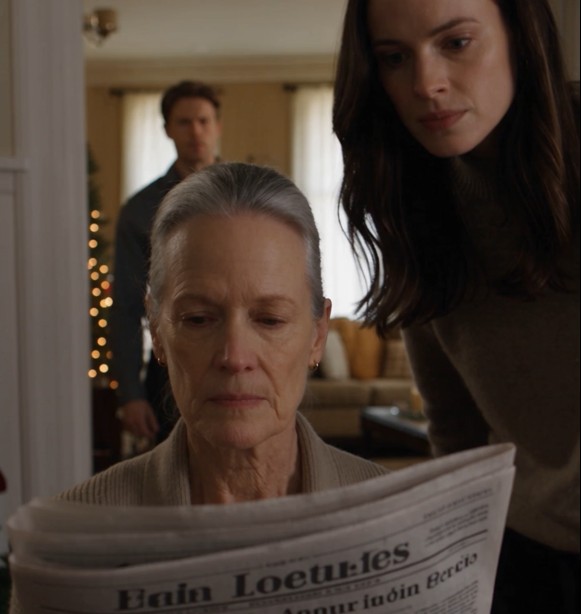
For a while, we saw each other every Sunday. Sometimes we ate at my house. Sometimes we walked to the park. Brooke and I learned how to speak without Julian between us.
She apologized for the newspaper.
I apologized for allowing resentment to make me quiet.
Neither apology erased the event. That was not what apologies were for. They made it possible to remember the event without allowing it to govern every future conversation.
One rainy afternoon, Brooke came to my house alone.
She stood just inside the door, holding a flat cardboard box.
“I found this in Julian’s things,” she said.
My stomach tightened.
“What is it?”
“I don’t know.”
She placed it on the table.
Inside was a stack of envelopes tied with faded blue ribbon. The handwriting on the top envelope was my husband’s.
My breath stopped.
He had died nine years earlier.
I touched the paper without opening it.
“Where did he get these?”
“Julian said he found them in the attic when he was looking for tax records.”
I looked at her. “Did he read them?”
“He said no.”
The envelopes were addressed to me but never mailed. My husband had written them during the last year of his illness, when his hands shook too badly to sign checks but still worked well enough to hold a pen.
I opened the first letter.
My dear Margaret,
If you are reading this, then I finally found the courage to leave you words instead of unfinished sentences.
I had to stop.
Brooke turned away, giving me privacy without leaving.
The letters described things I had never known. My husband had realized how much I was doing for Julian and had worried that our son had learned to confuse being loved with being rescued. He had written that Julian was not cruel by nature, but that fear could make a person cruel if no one stopped him.
The final letter was dated three days before my husband died.
I read it twice.
There is one thing I need you to remember. The house is not a reward for being good, and it is not a punishment for being loved. It is the place where you get to decide what peace looks like. Give it away only when giving it brings peace. Keep it when keeping it protects the life you have left.
Below the sentence was a second line.
And if Julian ever believes you must choose between being his mother and being yourself, choose yourself. That is the only way you can remain someone worth coming home to.
The room blurred.
Brooke sat beside me.
“I didn’t know,” she whispered.
“Neither did I.”
I pressed the letter against my chest.
The beautiful twist was not that my husband had predicted the exact shape of the betrayal. He had not. He had understood something larger: the danger of making one person responsible for another person’s salvation.
He had left me permission to live.
For years, I had believed the house was the last thing he had given me. Now I understood that it was not the house.
It was the boundary.
It was the voice telling me that love did not require surrender.
I showed Brooke the letter.
She read it silently. When she finished, she wiped her cheeks with the heel of her hand.
“Julian needs to read this someday,” she said.
“Maybe.”
“Not to punish him.”
“I know.”
“To let him understand that your husband saw the danger before any of us did.”
I folded the letter carefully.
“Someday,” I repeated.
That summer, I turned the guest room into a proper room for Evan. The moon lamp stayed on the nightstand. Brooke helped paint one wall a soft blue. Evan chose a line of wooden stars for the shelf.
Julian was allowed supervised visits at a family center. The first one lasted twenty minutes. The second lasted forty. He brought Evan a new dinosaur and spent most of the time on the floor, letting his son decide which game to play.
He did not ask Evan to forgive him.
That was how I knew counseling was beginning to reach him.
One evening, after a visit, Evan asked me whether his father was still bad.
I set two mugs of cocoa on the table.
“People can do bad things without being bad in every part of themselves.”
“Is Dad good?”
“He is responsible for becoming better.”
“Can he?”
