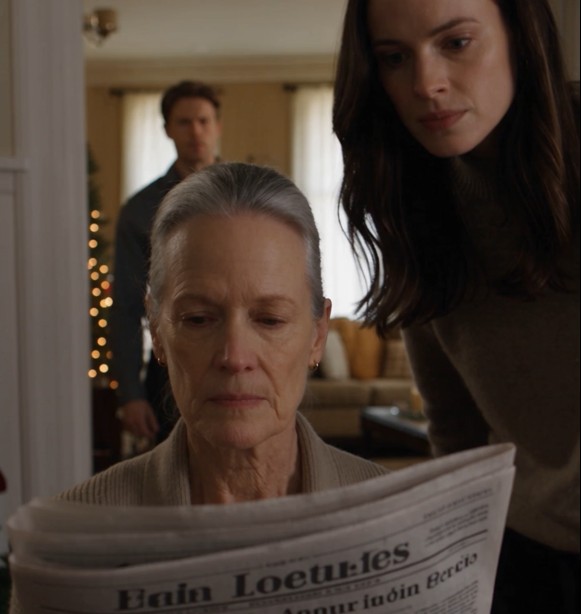
My daughter-in-law snatched the newspaper out of my hands.
“Then stop pretending you help.”
For a second, I stayed perfectly still, my fingers curled around the empty space where the paper had been.
Brooke stood over me in my own house.
She had moved in fifteen hours ago.
Not fifteen months. Not fifteen weeks.
Fifteen hours.
“Selfish?” I said, looking up at her. “You moved into my house fifteen hours ago, Brooke. I’m not your Christmas babysitter.”
Her grip tightened around the newspaper.
I waited for her to hear herself. To look at what she had just taken from my hands and realize who she was speaking to.
Instead, she held my gaze.
There was something almost certain about her anger, as though I had broken an agreement everyone understood except me.
I lowered my empty hands into my lap.
“I pay your phones, your gas—”
“Julian pays those.”
She said it immediately.
No hesitation. No glance toward the doorway. Just my son’s name, delivered like a fact that should have embarrassed me into silence.
My mouth stayed open for a moment.
Then I closed it.
Of all the things she could have said, that was the one I hadn’t expected.
I knew where that money came from. I knew whose money kept their phones working and covered their gas.
But Brooke wasn’t looking at me like someone bluffing.
She was looking at me like someone who believed every word.
That was when Julian appeared in the doorway.
I turned toward him, waiting for him to correct her.
He had heard enough. He could have settled that part of the argument with a sentence.
I watched his face.
Brooke still had my newspaper. Julian remained in the doorway. And somehow, in the house I owned, I was the one being asked to defend whether I helped.
“No,” I said. “I do. And today, I’m canceling everything.”
The words came out steadier than I felt.
I expected Brooke to scream.
I expected the newspaper to hit the floor, or another accusation, louder this time.
Instead, she went white.
Her eyes moved away from me.
Slowly, she turned toward my son.
“Julian,” she whispered.
Something in that whisper made me stop moving.
“You said the money I gave you every month was paying your mother for childcare.”
I looked at her.
Then at him.
Every month.
Not money she had offered once. Not a conversation about what they might contribute after moving in.
Money she said she had been giving him.
I waited for Julian to look confused. To ask what she meant. To say there had been some misunderstanding.
He stared at me.
Brooke stood between us, still holding the newspaper she had taken as if I were the person who owed her something.
I drew a breath.
“How much money, Brooke?”
Brooke’s fingers loosened around the newspaper.
It slid against her palm and fell onto the carpet, folding open across an advertisement for assisted living apartments.
“Eight hundred,” she said.
The room seemed to contract around the number.
“Eight hundred what?”
“Dollars. Every month.”
Julian moved then, but only half a step. His shoulder struck the doorframe. The sound was small, yet it seemed to travel through the entire house.
I looked at him.
“Since when?”
His face had emptied of color.
“Mom—”
“Since when, Julian?”
