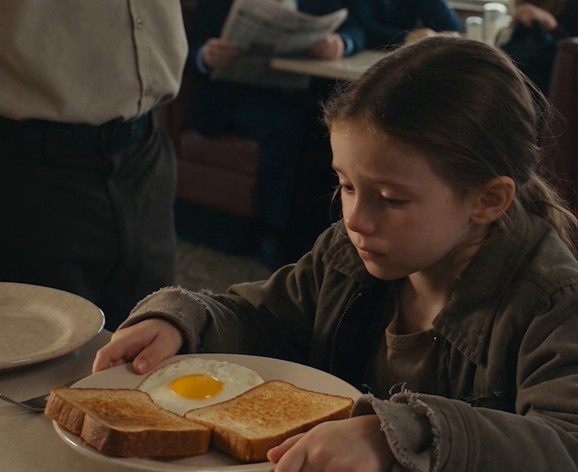
Twenty years later, the bell above that same diner door rang again.
A woman stepped inside.
She looked around the room without saying a word.
Then her eyes stopped on the kitchen door.
Something shattered behind it.
The woman’s fingers tightened around the small envelope in her palm. Through the circular window she saw an apron, a bent shoulder, and a hand braced against the stainless-steel counter.
“Leave it, Ruth,” someone snapped. “You’ll only drop another.”
The woman crossed the diner before she realized she was moving.
The kitchen door struck her shoulder as she pushed through. Broken crockery glittered around a pair of swollen ankles. The woman in the apron was older now, her hair almost white, but when she looked up, the stranger recognized her mouth before anything else.
That was the mouth that had smiled.
“Don’t move,” the younger woman said. “There’s a piece beside your shoe.”
She took a broom from the wall.
“You can’t be back here.”
The manager stood beside the refrigerator. His hair had thinned. His voice had not changed.
Then recognition of a different kind brightened his face.
“Ms. Bell. We weren’t expecting you until eleven.”
Mara looked from him to Ruth.
“I came early.”
Victor Harlan straightened his tie. Three weeks earlier, he had shown her financial statements, equipment inventories, and photographs carefully framed to exclude the people working here. He was selling the business. Her accounting firm had been examining it on behalf of a neighborhood food cooperative.
He had called his staff a reliable, low-cost asset.
Now Mara understood precisely what he meant.
Ruth reached for the broom.
“Please,” Mara said. “Let me.”
She swept the fragments into a dustpan, then pulled a chair away from the preparation table. Ruth hesitated before sitting, watching Victor instead of the seat.
Mara noticed that, too.
“Could we have a minute?”
“We have a breakfast rush.”
There were four customers outside.
“A minute,” Mara repeated.
Victor left without answering. The swinging door settled between them.
Mara put the envelope on the table. Inside lay eight dollars and forty cents, folded around a much older scrap of paper.
“I’ve been carrying this since my first summer job,” she said. “I kept thinking I’d come back when I had something better to say.”
Ruth looked at the money.
“I don’t understand.”
“Eggs. Toast. Potatoes. Orange juice.”
Ruth’s eyes moved slowly to Mara’s face.
“My coat was too big,” Mara continued. “You let them take it from your wages.”
The refrigerator motor stopped. In the sudden quiet, Ruth covered her mouth.
“You ate so carefully,” she whispered. “Like someone might change their mind.”
Mara had prepared sentences in hotel rooms and airport lounges. She had practiced explaining her degree, her business, the life that had become possible.
None survived that observation.
“Yes,” she said.
Ruth reached across the table, but stopped short of touching her.
“Did you find your people?”
“My mother was in the hospital. Our neighbor was supposed to look after me, but she worked nights. I went out looking for food.”
She swallowed.
“Mom recovered. We had another seventeen years.”
Ruth closed her eyes briefly.
“Oh, sweetheart.”
Mara pushed the envelope toward her.
Ruth pushed it back.
“No.”
“It’s not enough. I know that.”
“That isn’t why.”
The door opened.
Victor glanced at the envelope, then at their faces.
“Well,” he said. “A reunion. Wonderful. Ruth, the grill.”
Mara stood.
“We need to discuss the payroll records.”
His expression changed so slightly that she might once have missed it.
