“You didn’t pay.”
The waiter’s voice cut through the diner like a knife.
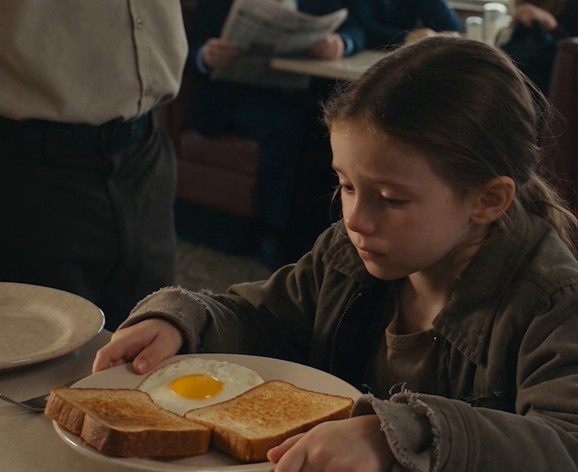
The little girl froze beside the table, both hands still wrapped around a chipped breakfast plate.
She looked eight years old.
A thin coat hung from her shoulders. Her sleeves were dirty. Her shoes had been worn through by too many winters.
On the plate were two eggs, toast, and potatoes.
To everyone else, it was an ordinary breakfast.
To her, it looked like survival.
“I’m sorry,” she whispered.
The waiter stared at her for one cold second.
Then he snatched the plate from her hands.
“Sorry doesn’t buy breakfast.”
The ceramic plate scraped against his fingers as he carried it away.
The diner went silent.
Only for a moment.
Then everyone looked away.
A businessman lowered his eyes behind his newspaper.
Two teenagers laughed quietly at the counter.
A woman tightened her grip on her purse as if the child had somehow become dangerous.
The little girl stood beside the table with empty hands, staring at the floor.
She was trying not to cry.
That was when the kitchen door swung open.
A tired woman stepped out wearing a stained apron. She looked toward the child, then toward the plate sitting on the counter.
She didn’t ask questions.
She simply picked up a clean plate.
One by one, she filled it herself.
Eggs.
Toast.
Potatoes.
Then she poured a glass of orange juice and carried everything to the little girl’s table.
The child looked up at her, confused.
“It’s okay,” the woman said softly. “You can eat.”
For the first time that morning, the girl reached toward the fork.
But before she could take a bite, the manager appeared.
He stood beside the woman, blocking the light from the kitchen.
“That’s coming out of your pay,” he said.
The woman’s hand stopped near the edge of the table.
For one painful second, worry flashed across her face.
The girl saw it.
She saw the stained apron.
She saw the manager’s expression.
She saw the breakfast that had suddenly become a debt.
The woman looked down at the child.
Then she quietly nodded.
“Okay.”
The little girl’s fingers tightened around the fork.
She understood.
This stranger was losing money so she wouldn’t stay hungry.
Tears filled her eyes.
The woman turned toward the kitchen, but before she disappeared behind the swinging door, she stopped.
She looked back and offered the child a gentle smile.
“When you can help someone someday… help them.”
The girl stared at her as if those words had been carved into the air.
Then she whispered, “I won’t forget this.”
The woman returned to the kitchen.
The manager followed.
The diner slowly began moving again, as if nothing had happened.
But the little girl remained frozen beside the plate.
Her hand closed around the fork.
And somewhere inside that small, frightened heart, a promise began.
