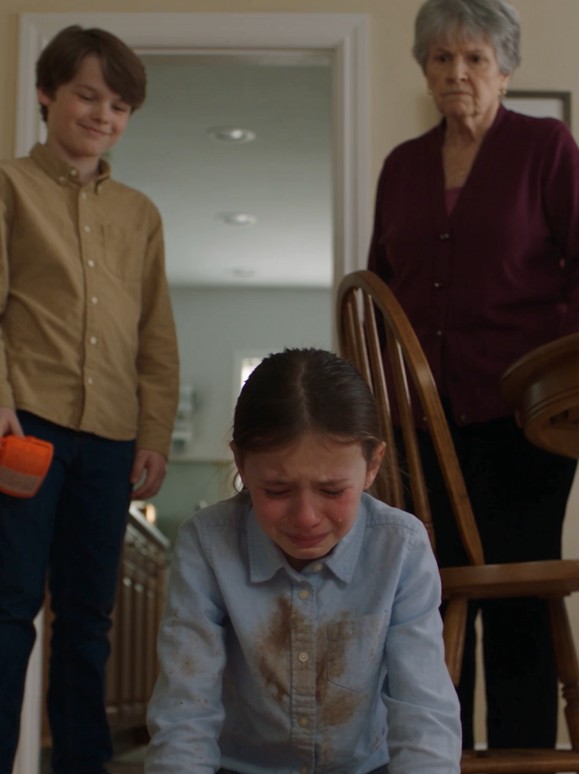
She took one step toward him.
“Go upstairs.”
He backed away.
“She said if we told, Mom would send me away.”
His mother’s face hardened.
“That is enough.”
“No,” I said. “It isn’t.”
My daughter’s fingers had not left mine. Her nails were digging into my skin, but I did not pull away.
Daniel read the page again.
“What is ‘separated from childish habits’ supposed to mean?”
“It means she was spoiled.”
“You wrote that she wasn’t allowed to call her mother.”
“She was crying because she wanted attention.”
“She was six.”
The room went silent.
That was the first time Daniel had said his mother’s behavior aloud in a way that could not be softened.
His mother turned toward him.
“You were raised properly.”
“You were afraid of me,” he said.
She stared at him.
Daniel’s voice shook, but he did not lower it.
“You were afraid I would be disappointed in you. You were afraid to cry in front of me. You told me that was respect.”
“I made you strong.”
“You made me apologize whenever you hurt me.”
Her face tightened.
I had heard fragments of this before. A childhood in which Daniel was expected to stand still while his mother criticized his posture, his grades, his friends, his voice. He had always dismissed it as strict parenting. Whenever I asked why he became silent around her, he said she had done her best.
Now he seemed to be seeing the shape of his childhood inside the pages on the floor.
His mother reached for him.
“You are letting her poison you.”
Daniel took a step back.
“I’m reading your handwriting.”
That stopped her.
Behind me, my daughter began to cry again, but this time she did not hide the sound. She leaned against my hip and sobbed with the exhausted force of someone who had been holding everything inside for too long.
I pulled her into my arms.
My mother-in-law looked at her with disgust.
“See? This is exactly the behavior I was correcting.”
I turned my body so my daughter faced my shoulder.
Daniel’s hands curled into fists.
“Get out of the house,” he said.
His mother laughed once.
It was a brittle, disbelieving sound.
“This is my house.”
“It is our house.”
“You would throw me out because of a few notes?”
“There are months of notes.”
“Notes that prove I was trying to help.”
“Notes that prove you were hurting my child.”
The cousin’s mother had arrived at the doorway sometime during the argument. She stood there with one hand over her mouth, her purse still hanging from her shoulder.
She had probably heard enough.
Her son ran to her.
“Mom.”
She knelt and pulled him against her.
“What did she make you do?” she asked.
The boy buried his face in her neck.
His grandmother looked at the woman sharply.
“Do not encourage him.”
The boy’s mother rose slowly. Her face was pale.
“I left him here because you said you would watch him.”
“I did watch him.”
“You told him to make her do everything.”
