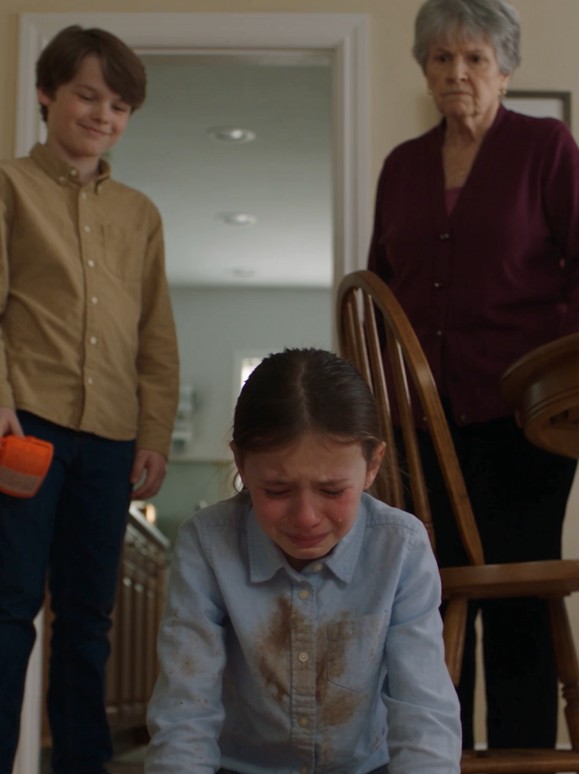
Then months.
My mother-in-law lunged toward the papers.
“Those are none of your business!”
My daughter caught my hand before I could pick up another sheet.
“Mom…”
She pointed to a page buried beneath the others.
“Look at the oldest one.”
I worked it free and began unfolding it.
My daughter’s hand tightened around mine.
What was on that first page that she needed me to see—and her grandmother had tried so desperately to keep hidden?
The paper tore slightly beneath my fingers.
A small corner broke away and fluttered to the floor.
My mother-in-law made a sound that was not quite a shout and not quite a plea. She dropped to her knees and grabbed for it.
I moved faster.
I lifted the page above my head.
The ink had faded, but the writing was unmistakably hers.
At the top was a date from eleven months earlier, three days after I had accepted a new position across town and begun leaving my daughter with her grandmother in the afternoons.
Underneath it, in a column ruled with a black pen, were sentences that made the room tilt around me.
“Refused to obey.”
“Cried when corrected.”
“Told her mother.”
“Must be separated from childish habits.”
At the bottom, my mother-in-law had written, “Begin responsibility training. No comfort until task is complete.”
My daughter pressed against my side.
I could feel her trembling through her shirt.
“What does this mean?” I asked.
“It means you are an irresponsible mother,” my mother-in-law said. “It means someone had to teach her discipline while you were busy chasing a career.”
I looked at the page again.
There were more lines on the back.
“Do not let her call her mother during correction.”
“Tell her Mother will be disappointed.”
“Use cousin as authority.”
The words blurred.
My daughter had told me three times in the past year that she did not like coming here. Each time, my mother-in-law had laughed and said she was being dramatic. I had believed the explanations because my daughter had always been cheerful when I picked her up, climbing into the car with a smile that seemed to return the moment the house disappeared behind us.
Now I understood that smile.
It had not been happiness.
It had been relief.
My husband came through the front door then, carrying two grocery bags. He stopped when he saw the chair overturned, the papers spread across the floor, and his mother kneeling with one hand extended toward me.
His eyes went immediately to my daughter.
“What happened?”
His mother stood up so quickly that the papers beneath her shoes crumpled.
“She attacked me.”
I turned toward him.
“She shoved me.”
“She was provoking me,” his mother snapped.
My husband looked from her to me. His mouth opened, but no sound came out.
I held the page toward him.
“Read this.”
He did not move.
“Daniel,” I said.
His mother flinched at his name, as though hearing it had reminded her that he was no longer a child she could command.
“Do not bring him into your hysteria,” she said. “You have always tried to turn him against me.”
Daniel finally set the grocery bags on the floor.
He took the paper.
His expression changed line by line.
The cousin, a boy of nine with a plastic truck clutched against his chest, began to cry quietly. He had been silent through the argument, but now he wiped his face with his sleeve and stared at the lists.
“Grandma said we couldn’t tell,” he whispered.
Daniel looked at him.
“Tell us what?”
The boy glanced at his grandmother.
