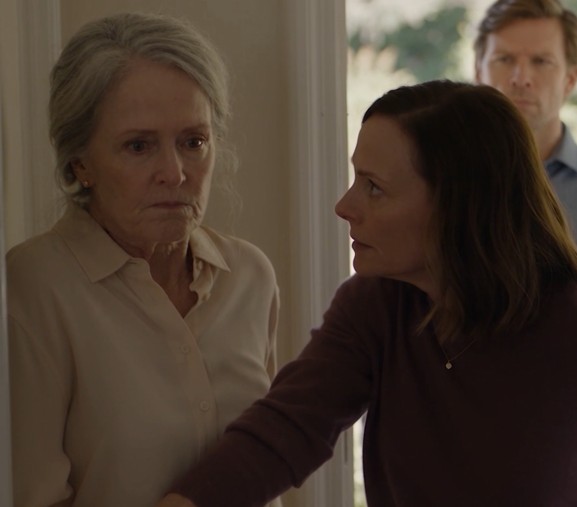
She had not broken into my home to save me.
She had broken in because she believed the paperwork would make resistance unnecessary.
Grace placed the new estate documents on the entry table. Then she took a second folder from beneath her arm.
“I brought copies of everything,” she said. “The forged authorization, the nursing-home application, the email exchange between Melissa and Todd, the wire transfers, and the security footage from the bank.”
Melissa’s head snapped toward her.
“What wire transfers?”
Todd closed his eyes.
The room seemed to contract around him.
Grace looked at me before answering. She was giving me the choice to hear it from her or from them. I nodded.
“Two payments were made from your investment account,” she said. “One for nine thousand dollars, one for fourteen thousand. They went to a debt-consolidation company. The account was opened under your name, but the recovery email belonged to Todd.”
I heard the words, but my mind refused to give them shape.
I had noticed the missing money. I had blamed my failing memory. I had searched drawers, bank statements, and old notebooks, wondering whether I had misplaced something. Melissa had told me that confusion was the first sign of decline.
Now I understood why she had been so patient whenever I questioned a bill.
She had been waiting for me to doubt myself.
Todd took one step backward.
“I was going to put it back.”
“You used her money to pay your gambling debt,” Grace said.
His face tightened.
Melissa stared at him. “You told me the money was for the deposit.”
“It was supposed to be.”
“You told me we were buying the care facility a bed.”
“I needed time.”
“You told me she had already agreed.”
“I thought she would.”
The words fell apart between them.
For years, I had tried to understand why my daughter had become distant. I had measured every conversation for signs that I had failed her. I had apologized for raising my voice when she was seventeen, for working too much when she was young, for not knowing how to help when her marriage began to fracture.
I had never imagined that her distance was not grief or resentment but calculation.
Still, I could not make myself believe that calculation was all she had ever felt.
“Melissa,” I said.
She turned to me.
Her eyes were wet now, but her tears did not move me the way they once would have. I had learned, in the last hour, that tears could be a door someone opened when they wanted access to the room behind your heart.
“Did you know about the money?”
She opened her mouth.
Nothing came out.
That silence answered me.
Todd lowered his head.
Melissa pressed both hands against her stomach, as though she were trying to hold herself together physically.
“I knew he borrowed it,” she said. “I didn’t know how much.”
“You knew enough to help him.”
“I thought we could fix it.”
“You helped him create papers saying I was incapable of managing my own life.”
“I was scared.”
“You were standing in my doorway with a locksmith.”
Her shoulders flinched.
“I was scared,” she repeated, but the words sounded smaller now, almost childish. “We had nowhere to go.”
Grace’s expression hardened. “You had options.”
“Not ones that kept Sophie safe.”
At the sound of her name, something inside me shifted.
“Do not use Sophie as a shield,” I said.
Melissa looked toward the staircase. “She needs stability.”
“She needs to know that the adults around her will not steal from the person who loves her.”
“She needs a home.”
“She already has one.”
“You think a trust fixes everything?” Melissa demanded. “You think putting a house in her name makes you a better grandmother than I am a mother?”
“No,” I said. “I think keeping your hands off it is the first thing that might give Sophie a chance to grow up without learning that love means taking.”
The hallway went still.
Then a door opened upstairs.
Sophie stood on the landing in her pajamas, one hand wrapped around the banister. She was old enough to understand the tone of our voices and young enough to believe that every adult argument might become permanent.
Melissa went white.
“Sophie,” she whispered.
