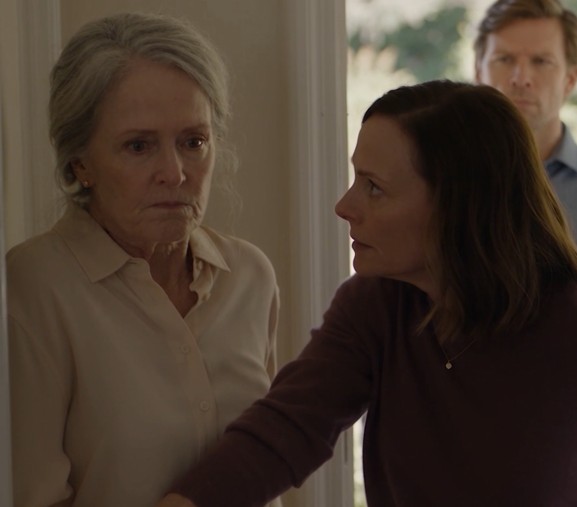
Then she looked at Sophie.
“I’ll write first.”
Sophie nodded.
Melissa opened the door herself.
She stepped onto the porch, paused beneath the light, and walked down the path without looking back.
I closed the door.
For a moment, my hand rested on the lock.
Then I turned it.
Not to keep her out.
To remind myself that the choice was mine.
In the spring, the garden came back.
Tulips rose along the fence where my mother had planted them. Sophie built a small table beneath the apple tree and painted it blue. Grace brought sandwiches every Saturday and complained that none of us knew how to prune anything correctly.
Melissa came on Sundays.
She never arrived empty-handed. Sometimes she brought bread. Sometimes library books. Once she brought a packet of tulip bulbs and asked permission before planting them.
The first time she asked, I nearly laughed.
“You do not need permission to plant flowers.”
“I do here.”
The answer stayed with me.
She was not asking permission because she was weak. She was asking because she had finally learned that another person’s space was not an obstacle to overcome.
The legal case ended without prison, but with probation, restitution, mandatory counseling, and a permanent financial restriction that required an independent trustee to review her accounts. She lost her job after the investigation. She moved into a small apartment and began working at a community center.
She told me she had learned that some people there were not ready to forgive her.
“I understand them,” she said.
“You do not have to make forgiveness their assignment.”
“I know.”
Her relationship with Sophie grew carefully.
There were still days when Sophie became angry without warning. There were days when Melissa left early because she could see the visit was becoming too difficult. There were days when I wanted to tell them both how to heal faster.
I learned not to.
The house held their silences.
It held the sound of Sophie practicing piano.
It held Melissa washing dishes after dinner.
It held Grace laughing in the living room.
It held me walking from room to room at night, touching the doorknobs, feeling the quiet settle into something that no longer resembled fear.
On the day Sophie turned twenty-five, I gave her the trust documents.
She had expected a ceremony. Instead, I placed them on the kitchen table beside the old brass key.
She stared at both.
“I thought you would make a speech.”
“I have made enough speeches.”
She opened the folder.
“Are you giving me the house today?”
“I am giving you the choice today.”
She looked out the window at the garden. The blue table had faded. The apple tree was heavy with blossoms.
“I want to keep it,” she said.
“I know.”
“But not because I have to.”
“No.”
“I want Mom to have a room here.”
Melissa, who had been standing near the doorway, went still.
Sophie continued, “Not ownership. Not control. Just a room, if she wants one.”
Melissa’s eyes filled.
She turned to me.
I felt the old instinct rise inside me, the instinct to decide quickly so nobody would feel uncomfortable.
I let it pass.
“This is Sophie’s house,” I said. “She decides.”
Sophie looked at Melissa.
“Do you want one?”
Melissa wiped her eyes.
“Yes,” she said. “But only if I can leave it whenever you ask me to.”
Sophie nodded.
“Then you can have one.”
No one moved.
