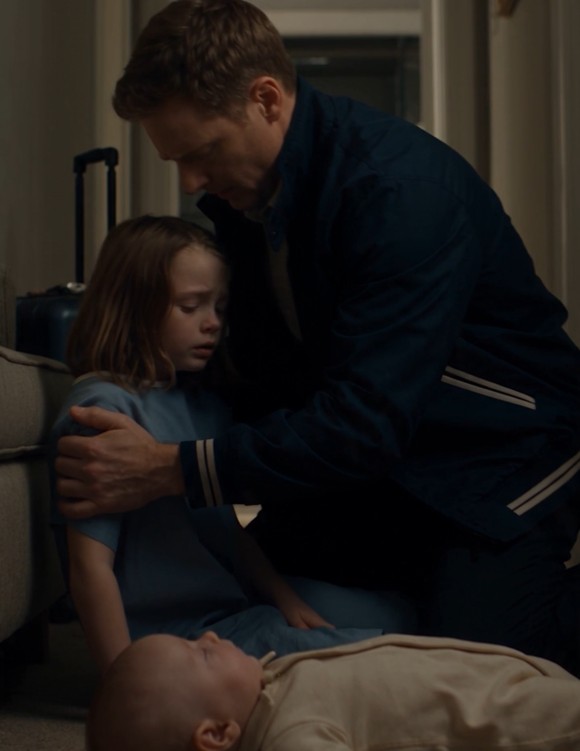
Claire wrote letters.
The first was six pages long and full of apologies.
Lily did not want to read it.
The second letter contained no request for forgiveness. Claire wrote about the things she remembered: Lily’s favorite pajamas, the way Tommy clenched his toes when he was sleepy, the song she used to sing during bath time.
Lily asked me to read that one aloud.
I stopped whenever she wanted.
At the end, she said, “She remembers us.”
“She does.”
“But she didn’t protect us.”
“No.”
Lily folded the letter and put it in a box beneath her bed.
“She can remember us from far away.”
That became the boundary.
Claire lived in a small apartment under supervision. She attended therapy three times a week and sent the children drawings without messages. Some they kept. Some they threw away.
Healing did not move in a straight line.
Lily began sleeping through the night, then stopped when a delivery truck backfired outside the house.
Tommy laughed for the first time six weeks after we came home from the hospital. The sound startled me so badly that I dropped a glass in the kitchen.
Lily laughed at me.
“You’re not supposed to cry when he laughs.”
“I’m allowed to cry.”
“Not in the cereal.”
“I’ll try to remember.”
The house changed.
The locked room was emptied by investigators, then sealed. I could not bring myself to keep it as storage. I painted the walls white and removed the door entirely.
Lily chose the new room’s color.
Yellow.
Not bright yellow. A soft, warm shade that made the space look full of morning even at night.
We put bookshelves along one wall. Tommy’s crib went beneath the window. Lily placed her art supplies on the floor and made a sign for the door.
It read:
KNOCK FIRST.
I kept it exactly where she put it.
I also sold the company.
The new owner kept most of the employees and retained my assistant, who had been the first person to question the missing transfers. I created a trust for Lily and Tommy, paid every outstanding debt, and moved the rest of the money into accounts they could access when they were adults.
For the first time in my life, I stopped measuring days by what could go wrong.
I measured them by ordinary things.
Tommy learning to crawl.
Lily losing her first tooth.
The smell of toast burning because I was helping with homework.
The sound of rain against the windows while all three of us sat on the living room floor.
One afternoon, nearly a year after the night I found them, Lily came home from school carrying a small envelope.
She placed it on the kitchen table.
“What is it?” I asked.
“Dr. Shah said I could decide whether to show you.”
“Do you want to?”
Lily nodded.
Inside was a drawing.
It showed a house with three people standing in front of it. The sky was blue, and the windows were yellow. A smaller figure stood at the side, separated from the house by a wide patch of green grass.
“Who is that?” I asked.
“Mommy.”
“Why is she outside?”
“Because she has to learn how to come close without making us scared.”
The answer was so precise that I could not speak.
Lily looked at me.
“Daddy, I have something else.”
She reached into the envelope and pulled out a folded sheet of paper.
It was old and creased.
“I found it in the room,” she said. “Behind the vent.”
My heart began to pound.
The police had searched the room. They had found documents, recordings, and letters, but they had not mentioned anything behind a vent.
I unfolded the paper.
