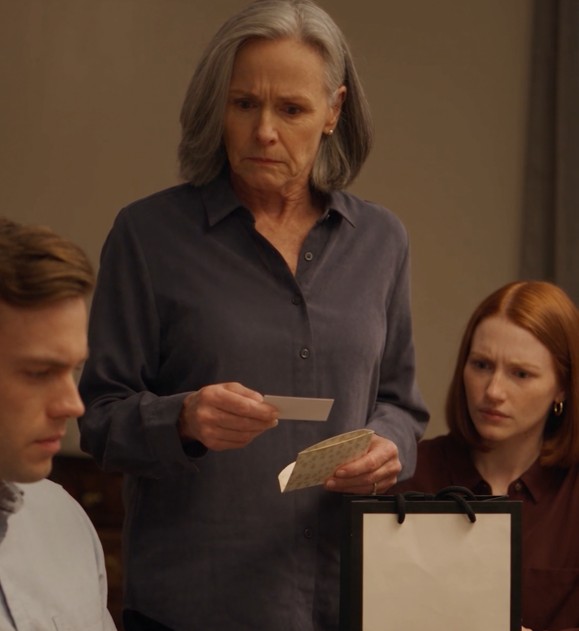
I didn’t realize I had sat down until Brooke knelt several feet away from me, holding a glass of water she didn’t try to put into my hands.
Across the room, Margaret said, “He stepped in front of me.”
Nobody answered.
“He wouldn’t move.”
The detective cautioned her and stopped asking questions. She kept talking until she understood that her children were no longer trying to help her explain.
Then she asked for a lawyer.
They took her away that night while officers secured Evan’s car and the records he could identify. I watched her coat catch briefly in the doorway.
She tugged it free herself.
For months afterward, that small movement returned to me at strange times. Waiting for a kettle. Folding towels. She had been able to turn, adjust her coat, step over the threshold. Daniel had been left alone on wet pavement.
The investigation took longer than I wanted.
There were warrants, interviews, old photographs enlarged until the car in the background became recognizable. A body shop had retained pictures of the damage Margaret paid to repair sixteen months earlier. Those repairs were separate from the recent storm damage for which Evan had borrowed my money.
Daniel’s copies were found in a locked filing cabinet at the workshop. Bank records supported what he had told Evan. The voicemail established Margaret had been driving; physical evidence and the collision reconstruction dismantled her claim that Daniel simply walked into her path.
She had accelerated toward him. After striking him, she had reversed out and driven away without calling for help.
Her lawyer eventually advised her to accept a plea agreement.
She pleaded guilty to murder and financial crimes. The sentence meant she would spend the rest of her life in prison. Her company was dissolved, and assets were sold to repay the tenants whose deposits she had stolen.
At sentencing she spoke about stress, misunderstandings, and the burden of raising children alone.
She never said Daniel’s name.
When my turn came, I unfolded a page I had rewritten eleven times.
Then I put it down.
“My husband used to warm my side of the bed with a hot-water bottle,” I said. “He said I slept like someone waiting at a bus stop.”
A few people moved behind me.
“You have heard about accounts and evidence. I need you to know he was a person who noticed when people were cold.”
That was all I could manage.
It was enough.
Outside the courthouse, Evan stood apart from us near a bare tree.
“I should have gone to the police when I saw the car,” he said.
“Yes,” I answered.
His face crumpled, but I stayed beside him.
“I believed her because I’d blacked out before. Then I kept believing her because the other possibility was worse.”
“You let me hug you at his funeral.”
“I know.”
There was no answer that could repair that moment. We stood with it until his breathing steadied.
Evan cooperated fully, including admitting his own decisions afterward. The inquiry into his false statement ended without charges against him; the evidence showed how Margaret had manufactured his guilt. That finding freed him legally long before he felt free.
He entered treatment for his drinking. He found work at a different garage. Every month he sent a payment against his loan, with the balance written in careful figures.
I kept the receipts.
Brooke and Julian came to see me a week after that terrible dinner. They brought bank statements, the receipt showing the bag had been returned, and a transfer confirmation for the full forty-five hundred dollars.
Brooke placed the grocery card beside them.
“I need to explain this.”
I looked away.
“Mom brought it. She said money was tight and we should keep your gift small because you didn’t need anything. I knew it was cruel. I handed it to you anyway.”
“Why?”
Her fingers curled against her knees.
“Because making her angry still felt more dangerous than hurting you.”
Julian sat forward.
“And I let you find out in front of her because I was afraid you’d tell us to call the police before we were ready. I thought I was protecting Brooke. I made you the person who didn’t get a choice.”
For a while, I listened to the clock.
“I don’t want gratitude purchased with expensive presents,” I said. “I want you to notice when I’m standing in a room.”
Brooke wiped her face with her sleeve.
“I saw you,” she whispered. “That makes it worse.”
I appreciated that she didn’t ask me to disagree.
They moved into a modest rented apartment the next month. We put the arrangement in writing, returned their share of household expenses, and closed the accounts through which help had become expectation.
I sold the house.
Not immediately. First, I opened every window. I washed the table myself. Then I decided I didn’t want my savings tied to a place where I could still hear that knife striking china.
Our Sunday visits began in a café, lasted an hour, and sometimes ended badly.
Once Julian said, “I’ve apologized,” with a tiredness that made me put down my cup.
He stared at the table.
“That sounded like I was asking you to hurry.”
“Yes.”
He stayed. We finished our coffee. The following week he came back.
Brooke started counseling with someone who understood what years of fear could do to a family. She stopped reporting Margaret’s letters to us. Eventually she stopped opening them.
