Then I looked at my son, the child I had spent years protecting, feeding, and helping whenever he asked.
He finally met my eyes.
There was fear in them.
Not fear of losing the house.
Fear that I had discovered something I was never supposed to see.
I lifted the document between us.
“Knew what?”
He stopped breathing.
And my daughter-in-law reached for his arm.
What had they been hiding from me all this time?
Her fingers closed around his sleeve, and he jerked away so sharply that his elbow struck the doorframe. The sound cracked through the hall. Then his phone began vibrating in his pocket.
None of us looked down.
“Knew that the mortgage was gone,” she said. “That the money was repayment.”
“What repayment?”
He reached for the paper. I stepped back.
“The money we lent you for your roof,” she said.
Above us, a brown water stain spread across my hallway ceiling. She looked at it, then toward the kitchen, where a saucepan waited beneath another leak.
“I haven’t had my roof repaired.”
Her mouth stayed slightly open. My son took his phone out, silenced it, and put it away without checking the screen.
“Let me explain this privately, Mom.”
“No,” I said. “You brought her here. Explain it where she can hear.”
He rubbed both hands over his face. It was a gesture I remembered from unfinished homework, from the dent in my car when he was seventeen. I had always rushed to fill that silence with something merciful. This time, I waited.
“My grandmother left me money,” his wife said slowly. “We used most of it to clear the mortgage. He said you needed help, too. Eighteen thousand dollars.”
I put my free hand against the wall.
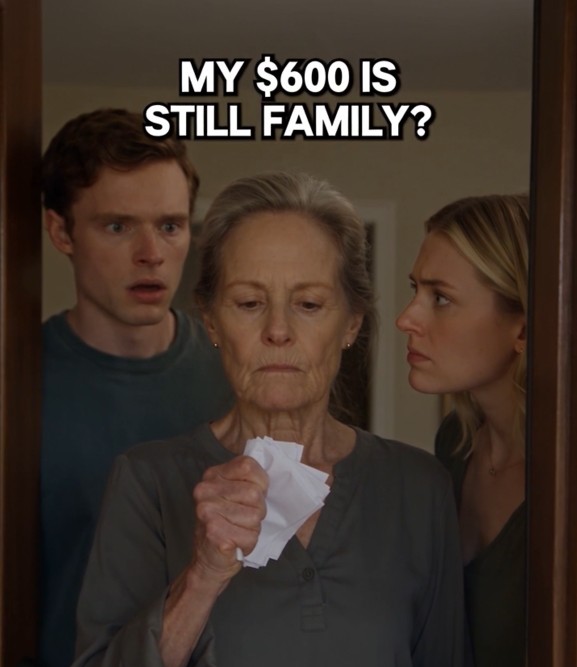
“He said you were embarrassed. That you wanted to repay it six hundred a month, and I wasn’t supposed to mention it because you’d feel ashamed.”
My son looked past me into the house, calculating something.
I understood then why she had stood in my doorway looking at me as though I were selfish. He had given her a different mother. A woman who borrowed money, avoided her obligations, and needed to be cornered into paying.
“And the house?” I asked him. “Why did you say you’d lose it?”
“There are other debts.”
His wife turned toward him.
“What other debts?”
He didn’t answer. She looked down at the payoff confirmation and shook her head once.
“I grabbed this from the mortgage folder. He told me we needed the account number to talk to you. I didn’t read it.”
She sounded sick now. That did not erase the paper striking my chest. But it changed the shape of what had happened.
“Eighteen months,” I said. “That’s ten thousand eight hundred dollars.”
“I know.”
“Do you? Because I know it in groceries. I know it in buckets when it rains.”
His eyes flicked toward the kitchen. For the first time, he seemed to see the saucepan.
His wife reached for her phone.
“I’m checking the savings account.”
He caught her wrist.
“Don’t start something you can’t take back.”
She went perfectly still.
I opened the front door wider.
“Let go of her.”
He released her, but slowly, as though he wanted us to understand that releasing her was his decision.
She moved to my side of the doorway.
That small crossing finished something between them.
He tried another voice then, the soft one he used when he wanted me frightened for him.
“Mom, I’ve made mistakes. If you give me a week, I can fix this.”
“With whose money?”
He stared at me.
I held out my hand.
“My key.”
For a moment, I thought he would refuse. Then he dragged his keys from his pocket, worked mine off the ring, and laid it in my palm.
It was still warm when I shut the door.
His wife remained in the hall with me. Through the glass, his shadow stood on the step, then shifted away. We listened until his car started.
“I should go,” she whispered.
“Can you drive?”
She looked at her shaking hands.
