“Yes.”
Jonah stared at him with an expression the old man had seen before: anger struggling against pity.
“I don’t know what to do with that.”
“Neither do I.”
“Are you going to hide it?”
“No.”
The old man picked up the phone.
He called the investigator who had prosecuted Silas.
He called the families.
He called every journalist who had covered Mercy House.
Then he called Anika.
The truth became public before sunset.
The court reopened the case. New charges were filed against Silas. The prison where he was held became the site of another investigation when records revealed that he had continued directing payments through hidden accounts.
He spent the rest of his life in a secure medical facility under permanent supervision.
The old man testified again.
This time, he did not speak as the owner of the foundation.
He spoke as one of its victims.
He described every injection, every dismissal, every time he had trusted Silas because it was easier than admitting he had surrendered control.
At the end of his testimony, the judge asked whether he had anything else to say.
The old man looked toward Jonah, Mara, Eli, Lina, and Anika.
“Yes,” he said.
His voice carried through the courtroom.
“I believed responsibility belonged only to the person who held the weapon. I was wrong. It also belongs to the person who gave the weapon a name, a budget, a building, and permission to continue.”
No one moved.
“I cannot undo what happened. I cannot return anyone to their family. But I can refuse to call ignorance innocence.”
Outside the courthouse, the winter sun broke through the clouds.
Jonah stood beside him.
“You didn’t have to say all that.”
“Yes, I did.”
“Why?”
The old man looked at Lina, who was asleep against Anika’s shoulder.
“Because she shouldn’t have to spend her life proving what happened to her.”
Jonah nodded.
For a while, they stood without speaking.
Then Jonah reached out and adjusted the old man’s scarf.
“You’re still terrible at dressing for the weather.”
“I have people for that.”
“You have me.”
“That is precisely why I’m concerned.”
Jonah laughed.
The sound surprised both of them.
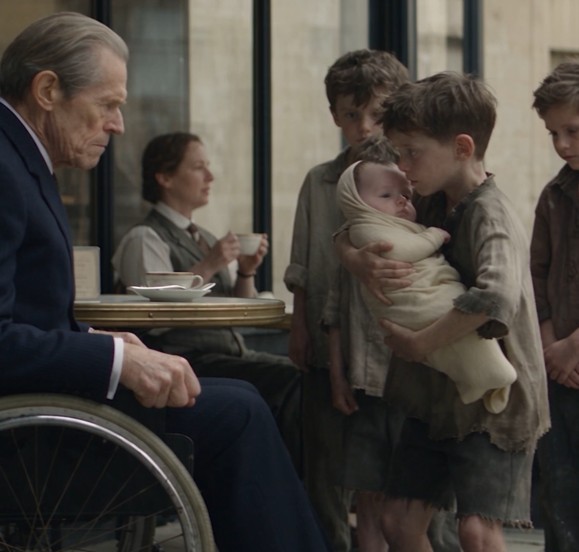
Years later, on the first warm day of spring, the children returned to the café where everything had begun.
The window had been replaced. The tables were different. The pavement had been washed clean so many times that no trace of the broken glass remained.
The old man sat beneath the same awning with his cane beside him.
Mara played her violin near the entrance. Eli chased a paper airplane across the sidewalk. Jonah carried Lina, who was no longer a baby but a quiet little girl with dark curls and watchful eyes.
Anika brought out a basket of bread.
The old man reached for a silver fork.
His hand stopped.
For an instant, the past rose around him: the laughter, the torn shirt, the trembling children, the old cruelty in his own voice.
Then Lina placed her hand over his.
He looked at her.
She smiled.
Not because she had healed him.
Because she remembered him.
The old man lifted the fork.
This time, his fingers did not shake.
Mara finished her song. Eli applauded too loudly. Jonah pretended to be embarrassed. Anika poured tea into chipped cups while the city moved around them in its ordinary, miraculous rhythm.
The old man looked at the children and understood the final truth.
The first time Lina touched him, he had thought she was giving him back his legs.
She had given him something harder.
