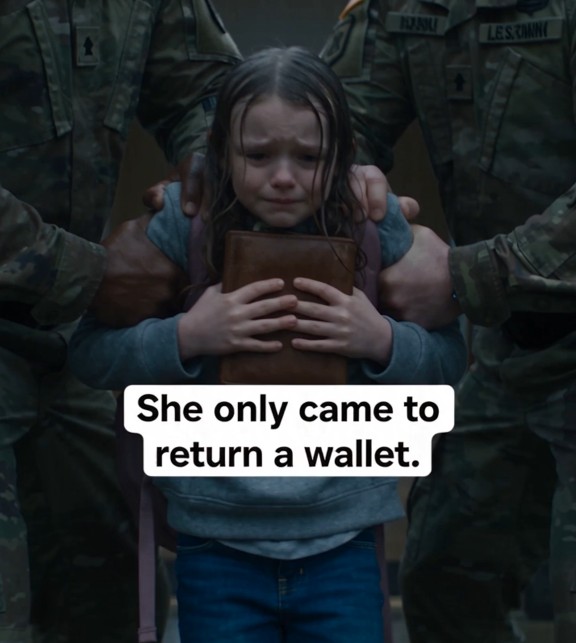
Major Lena Ortiz stepped inside, rainwater still darkening the shoulders of her field jacket. She had been on her way to the briefing when security stopped her in the corridor. “You ordered a full lockdown?”
“I need you to trace every action Colonel Sloane has taken involving my family records for the last twelve years.”
Ortiz did not ask why. She simply sat at the terminal beside him and began working.
The room filled with the click of keys and the whisper of ventilators.
Graves stood at the window overlooking the parade ground, now empty beneath the storm. He saw not the field but a smaller room from twelve years ago. Eliana at twenty-three, face white with anger, telling him she was pregnant. Telling him she would not let him decide what happened to her child.
He had been newly promoted then, frightened by scandal, by gossip, by the brutal machine of military life that taught men to call sacrifice duty even when the sacrifice was someone else’s. He had told her he could arrange support, make things easier, protect her future.
She had heard what he had not been brave enough to say aloud.
Get rid of the problem.
She had walked out of his house in the middle of the night. He had waited until morning to call. By then her phone was disconnected.
For years, Sloane had assured him that investigators had found nothing. Eliana had left voluntarily. Eliana did not want contact. Eliana was safe somewhere.
Graves had accepted those answers because accepting them was easier than admitting the daughter he loved had left because he had betrayed her.
“General,” Ortiz said quietly.
He turned.
Her face had gone pale.
“I found a sealed account in Colonel Sloane’s name. It received quarterly transfers from a holding company connected to the landlord listed on that notice.”
Graves looked at the eviction paper.
Ortiz kept reading. “There are also surveillance requests. The address was monitored. Your daughter’s address.”
“How long?”
“Eleven years.”
The air seemed to leave the room.
“Why?” Graves asked.
Ortiz shook her head. “I am still pulling the records.”
The command room door opened without a knock.
Colonel Sloane stood there, immaculate in dress uniform, his silver hair dry despite the storm. Two armed security officers were behind him, but Graves saw at once that they were not escorting Sloane. They were following his instruction.
Sloane smiled faintly at the wallet on the table.
“I wondered where that went.”
Graves did not move. “Close the door.”
Sloane did.
“Where is my daughter?” Graves asked.
Sloane’s smile disappeared. “That is an odd question.”
“Do not insult me.”
“I have spent seventeen years preventing you from being destroyed by sentiment, Nathaniel. I would think I had earned better than accusations.”
“You monitored Eliana.”
Sloane’s eyes flicked to Ortiz. “Major, leave us.”
“No,” Graves said.
The colonel looked at him for a long moment. “Then you should hear it with a witness.”
He walked to the table and rested two fingers on his wallet. “Your daughter came to me after she left your house. She was terrified. She believed you would use your position to take her baby from her.”
Graves’s face hardened. “I never would have done that.”
“But you could have,” Sloane said. “That was the point. You had become a general before you learned what power sounded like to people who had less of it.”
The words found their mark, but Graves did not look away.
“She asked you for help?” he said.
“She asked me to make sure you could not find her.”
“And you did.”
“I moved her records. I established a quiet support channel. I made certain there was money when she needed it.”
Ortiz looked sharply at the screen. “The support payments stopped three years ago.”
Sloane gave a thin shrug. “Budgets change.”
“The payments did not stop,” Ortiz said. Her voice had become cold. “They were rerouted to your accounts.”
Silence spread across the room.
Graves saw the smallest change in Sloane’s eyes. Not guilt. Annoyance.
“You stole from her,” Graves said.
“I managed assets.”
“You made her poor.”
“I made her dependent on reality,” Sloane snapped. “You wanted a daughter who would forgive you because you threw money at her. I gave her the chance to live without you.”
“You put an eviction notice on her door.”
“I did what was necessary.”
Graves stepped closer. “Necessary for what?”
Sloane’s composure finally cracked. “For you to remain what this country needed you to be.”
The colonel’s voice rose, not loudly, but with years of resentment pressed into every word.
“You were going to resign when Miriam died. You were going to abandon your command for a girl who hated you and a child you had never met. I kept you focused. I carried your burdens. I handled the weak points in your life because you never had the stomach to make hard decisions cleanly.”
“You call this clean?” Graves asked.
