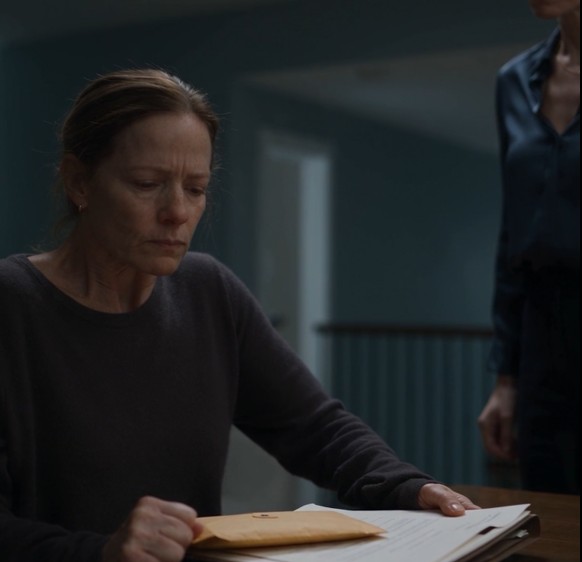
The house was no longer theirs to lose.
But it did not feel like victory.
Not yet.
Jacob moved into my guest room three days later.
He arrived with two suitcases, a cardboard box of books, and a plastic bag holding clothes that still smelled faintly of Ellie’s perfume. He set the bag down in the entryway and stared at it for a long time.
“I don’t know why I brought this,” he said.
“Because leaving is not clean,” I told him.
He nodded.
Then he carried it upstairs.
For the first week, he slept badly.
I would wake before dawn and hear the floor creak in the hallway. Sometimes I found him standing in the kitchen, staring into the dark backyard with a glass of water in his hand. Sometimes he apologized for making noise. Sometimes he apologized for eating the last of the bread. Once, he apologized because he had dropped a spoon.
Each time, I wanted to tell him that he had nothing to apologize for.
But I learned not to say it too quickly.
Instead, I would put the kettle on.
I would stand beside him without asking him to explain himself.
One morning, he found the old blue mug his father had made in a pottery class when Jacob was eight. The handle had been glued twice. There was a crooked yellow sun painted on the side.
Jacob held it between both hands.
“I thought you threw this away,” he said.
“I never throw away the things that matter.”
His eyes filled.
“I thought I was weak.”
I leaned against the counter.
“You were afraid.”
“That’s not better.”
“No,” I said. “It isn’t. Fear can make people do things they regret. But weakness would be choosing to stay cruel when you know better. You are here. You told the truth. You are looking at what happened even though it hurts. That is not nothing.”
He looked at the yellow sun on the mug.
“I don’t know how to forgive myself for leaving you downstairs.”
“You don’t have to forgive yourself today,” I said. “You have to stop pretending it did not happen. Then you have to become someone who would come downstairs next time.”
Jacob cried then.
Not loudly.
He bowed his head over the cracked mug, and his tears fell onto his hands.
I stood beside him until the kettle screamed.
Mara came by often.
At first, she stayed only long enough to bring groceries or sit with Jacob while I went to physical therapy for my wrist. Then she began staying for dinner. She would wash dishes without being asked. She would argue with Jacob about movies. She would open windows when the house felt too quiet.
She never acted as though she had rescued him.
She simply made room for him to become himself again.
One evening, while I folded laundry in the living room, I heard them laughing in the kitchen.
The sound stopped me.
It was not a huge laugh.
It was only Jacob, surprised by something Mara had said.
But it was the first unguarded sound I had heard from him in months.
I sat down on the arm of the sofa and closed my eyes.
The house had held so much silence.
It was learning a new language.
The legal process lasted nearly a year.
Ellie pleaded guilty to assault, forgery, identity theft, and conspiracy to commit fraud. Her attempt to blame Grant collapsed when investigators found messages showing that she had initiated the plan and pushed him to move faster. Grant pleaded guilty as well after investigators connected him to six other victims.
The court ordered restitution.
Ellie was sentenced to prison.
Grant received more time than she did.
Neither of them would ever own that house.
Neither of them would ever use my name again.
When sentencing day came, Jacob asked me to sit beside him.
The courtroom was cold, and the benches were hard. Ellie stood at the front in a dark uniform, smaller than I remembered. She did not look at us until the judge asked whether anyone wished to speak.
Jacob rose.
His hands shook.
But his voice did not.
“You convinced me that love meant enduring whatever you did to me,” he said. “You told me that if I left, I was betraying you. You told me I was selfish for wanting peace. You made me afraid of my own mother because you knew she was the person who might help me see what was happening.”
Ellie lowered her head.
“I am not speaking because I want you to hurt,” Jacob continued. “I am speaking because I spent too long trying to make your choices easier to live with. I won’t do that anymore.”
He looked toward the judge.
